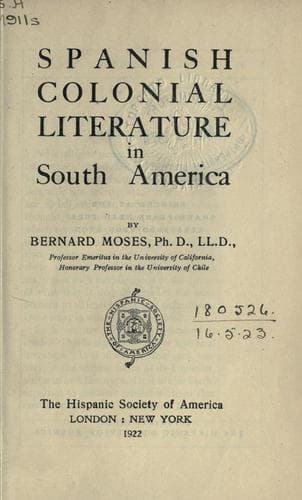
Spanish colonial literature in South AmericaMoses, Bernard
History
Spanish colonial literature in South America
Moses, Bernard
Spanish American literature -- History and criticism
_La Argentina_ must be viewed in its two aspects, as poetry and history,
and the passages illustrating these two phases are widely different
in spirit, even when the unlike passages are both founded on a basis
of facts. But in the poetic figures there are fewer references to the
fancies of pagan literature and mythology than may be found in the other
poems with which Centenera’s work may be compared. Now and then the
writer’s lamentations, raised to heaven because of the want and misery of
the company, reveal the ecclesiastic and suggest passages of the Psalms.
Volved con piedad, Señor, la mano,
Doleos de los tristes afligidos,
Doleos de los niños inocentes,
Que gritan con sus ojos hechos fuentes,
Doleos de las tristes afligidas
Que quedan sin abrigo y compañía:
También de las doncellas doloridas
Que pierden a sus padres y alegría.[92]
[Sidenote: Topics of later cantos]
[Sidenote: Spaniards’ views of their calamities]
From battles with the Indians in the region of Río de la Plata, the
founding of Buenos Aires by Juan de Garay, and the insurrection of
the mestizos at Santa Fe, Centenera, in his later cantos, turned to
happenings of his time on the western coast, to the exploits of Francis
Drake, the earthquake of Arequipa, and the council at Lima called by
Archbishop Mogrovejo. This change of subject appears to have been due to
the writer’s removal from the south-eastern province to Peru. Drake had
appeared about five years before this event, whence it may be presumed
the very favourable opinion of him expressed in _La Argentina_ was
that entertained by at least a part of contemporary Peruvian society.
Centenera found “this English and noble cavalier, given to the art of
the sea, a skilful pilot and sailor, a good soldier, astute, sagacious,
discrete, courteous, well-bred, brave, magnanimous, and a good friend,
but wanting in the greater and more necessary quality, _que es el amor a
Jesucristo_.” Centenera, as an ecclesiastic, was obliged by the spirit
of the Spanish Church in the sixteenth century to make this limitation
on the character of a Protestant. It is noteworthy, however, that he was
able to discover so much excellence in a subject of the “Babylonian
woman”; still this is partially accounted for when it is recalled that
the Spaniards in America regarded their calamities, whether brought about
by an English corsair or an earthquake, as a divinely directed punishment
for their shortcomings, and in this view the piratical agent of God might
appear to stand nearer the throne of heaven than those who suffered
the infliction. But they feared the invader not merely for his direct
influence, but as well for the influence he might have in awakening the
spirit of revolt among the Indians.
Public-domain text, read in full here on John Shaqi.
Reviews
Reviews
No reviews yet
Be the first to share your thoughts on this work.
Elsewhere in the archive
Join the Discussion
Join the discussion
Sign in to leave a comment or review.
Sign InorCreate an account