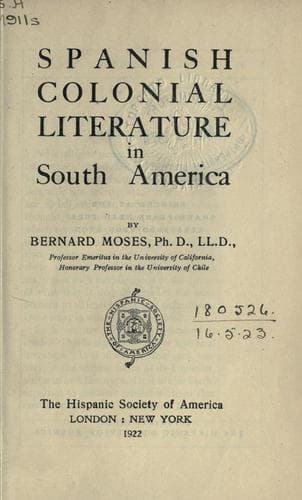
Spanish colonial literature in South AmericaMoses, Bernard
History
Spanish colonial literature in South America
Moses, Bernard
Spanish American literature -- History and criticism
In the beginning of the twenty-third canto Centenera expresses his wish
to write of what he saw in Peru during the meetings of the council
called by Archbishop Mogrovejo. This was the council that met on August
13, 1582, and held its last session on October 18, 1583. Its purpose
was to reform the discipline of the Church and to correct the manners
and customs of this part of the continent, but it was brought near to
disruption through the introduction of a question in dispute between the
Bishop and Canons of Cuzco.
[Illustration: El Marqués de Guadalcázar, 13th Viceroy of Peru 1622-1629]
[Sidenote: Dress reform in Lima]
[Sidenote: Decree of church council]
But the council acquired a difficult task when it undertook to reform the
dress of the women of Lima. It was the fashion for the women to appear in
the streets, in the churches, and in other public places with their faces
completely concealed by the rebozo. While protected by this veil it was
impossible for their identity to be observed or detected, whence arose
numerous abuses and scandals. Centenera refers to their conduct: “In
the streets and the square, they place themselves at the windows, where
it is a pleasure to see them, with their rich and very gay dresses, and
whoever wishes may speak with them; they do not appear shy or severe, and
listen to whomsoever wishes to flirt with them, and under their rebozos
they utter their little nothings, with which they sometimes fool little
boobies.” A proposition in relation to the conduct of the women and their
manner of dressing was brought before the council, which threatened with
excommunication those who persisted in wearing the rebozo to conceal
the face. Women should remain in their houses, or, if they appeared in
public places, it should be with their faces uncovered. For the time
being the majority of the women preferred to remain in their houses, but
a few of the rich, not objecting to the regulation, appeared in public
unveiled, for it gave them an opportunity to display their jewels. The
resolution of the council was, however, ineffective; the use of the
rebozo as a veil was continued. But about forty years later the Marqués
de Guadalcázar as viceroy (1622-1629) issued a royal ordinance, providing
that “no woman of whatever state, quality, or condition she may be, may
be veiled with a manto or in any other manner while going on the streets
of this city, or the alameda or other public places, whether on foot or
in a carriage or a sedan chair, or in balconies or windows, but that all
shall be obliged to go with their faces uncovered, to the end that they
may be seen and known, and the identity of each be recognized.”[93]
[Sidenote: Centenera’s motive in writing in verse]
Public-domain text, read in full here on John Shaqi.
Reviews
Reviews
No reviews yet
Be the first to share your thoughts on this work.
Elsewhere in the archive
Join the Discussion
Join the discussion
Sign in to leave a comment or review.
Sign InorCreate an account