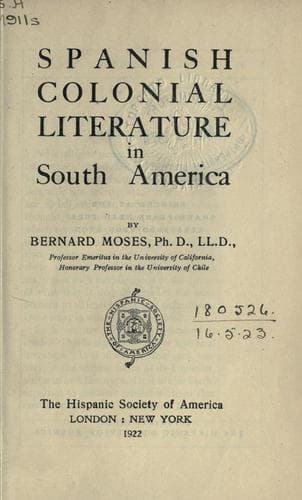
Spanish colonial literature in South AmericaMoses, Bernard
History
Spanish colonial literature in South America
Moses, Bernard
Spanish American literature -- History and criticism
The real character of _La Argentina_ is that of a contemporary chronicle,
and considering the breadth of his experience, the writer’s serious
mistake was that he adopted the form of verse instead of prose for
communicating his experience and his observations. But in his dedication
to the governor of Portugal, then united with Spain, Centenera affirms
that he has written in verse, although “poco polido y menos limado,” in
order that the Marqués de Castel Rodrigo, burdened with the grave affairs
of the government, might read it with greater facility than the long
and prolix histories he was accustomed to receive. The fact that it is
written in verse is perhaps the principal reason for including it in a
list with _La Araucana_; moreover, like _La Araucana_, it deals with a
colonial undertaking, the privations incident to a voyage from Spain, and
conflicts with the Indians. Juan María Gutiérrez finds its indisputable
merit in the frank sincerity with which the author communicates what he
saw and what he felt, and in this manner presented important data for the
early history of Río de la Plata.
[Sidenote: Nature of poetry]
[Sidenote: Poetry and music]
If one conceives of poetry not as the written metrical lines merely, but
as these lines uttered orally, he will have no difficulty in answering
the question critics have raised regarding the nature of the foregoing
metrical compositions. In this view, the words written in measured lines
may be compared with printed musical notes. These notes are not music,
but only directions for the production of vocal or instrumental sounds,
or combinations of sounds, which constitute music. In like manner, the
verses that stand on the printed page are indications of tone, accent,
and rhythm, and poetry is the utterance of these verses in accordance
with their proper indications. Endowed with a certain form and degree of
cultivation, one may derive sensations akin to those enjoyed in listening
to music, by reading the printed musical notes; and in the same way by
passing the eye silently over the printed verses one may experience some
of the emotions poetry is designed to awaken; but in neither case are
the emotions experienced more than a faint shadow of those aroused by
the voice of the skilful reader or by the violinist or the orchestra.
Poetry thus conceived is not the utterance of any distinct and exclusive
body of ideas, or of ideas that cannot be expressed except in metrical
language. There are no ideas set forth in the _Iliad_ or in _Childe
Harold_ that cannot be expressed in prose, and the same may be said of
_La Araucana_ or _Arauco domado_, treating not of the Trojan war, but of
the war against the Araucanians.
[Sidenote: What of _La Araucana_?]
Public-domain text, read in full here on John Shaqi.
Reviews
Reviews
No reviews yet
Be the first to share your thoughts on this work.
Elsewhere in the archive
Join the Discussion
Join the discussion
Sign in to leave a comment or review.
Sign InorCreate an account