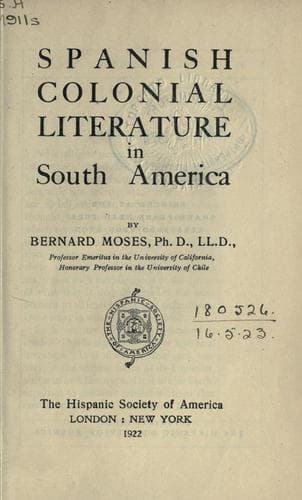
Spanish colonial literature in South AmericaMoses, Bernard
History
Spanish colonial literature in South America
Moses, Bernard
Spanish American literature -- History and criticism
Exalted ideas, or striking images, or mere commonplace thoughts may be
presented in prose, and verse possesses the same capacity; the main
difference between them would, therefore, seem to be that in verse
alone the words are selected so as to conform in their utterance to a
prescribed measure. Inevitably in different verses there is a more or a
less complete compliance with this rule; and this is characteristic of
the verses in question, as well as of many other verses; but when the
perfect verses of _La Araucana_ or _Arauco domado_ are pronounced in
their sonorous Spanish tones there is no doubt that we have before us
examples of poetry.
CHAPTER IX
WRITERS ON CHILEAN HISTORY 1600-1650.
I. _Alonso González de Nájera._ II. _Francisco Núñez de
Pineda Bascuñán._ III. _Caro de Torres._ IV. _Melchor Xufré
del Águila._ V. _Alonso de Ovalle._ VI. _Miguel de Aguirre._
VII. _Francisco Ponce de León._ VIII. _Diego de Rosales._ IX.
_Santiago de Tesillo._
I
[Sidenote: Spanish South America organised]
[Sidenote: Heads of the governments]
At the beginning of the seventeenth century, sixty or seventy years
after the occupation of Peru, New Granada and the region of the Río de
la Plata and its tributaries, the Spanish colonies of South America
had acquired their early form of organization. Peru was under the
government of a viceroy, whose jurisdiction was nominally coextensive
with Spain’s possessions in South America; but in New Granada, Chile
and the south-eastern provinces other centralized governments had been
established, subordinated to the viceroy in certain particulars and
directly dependent on the king in other respects. The head of each of
these subordinate governments was known as governor, captain-general, or
president as one or another of his principal functions was considered.
[Sidenote: Common ideas of the colonies]
As governor he was head of the civil administration, as captain-general
he was chief of the army or the militia, and his title of president
indicated his relation to the audiencia, a body that performed both
administrative and judicial functions and in case of a vacancy in the
governor’s office exercised the chief executive power in the dependency.
At that time, moreover, a number of towns had acquired sufficient
importance to have local governments consisting of a cabildo, or council,
composed of regidores and two alcaldes, the alcaldes serving as justices
of the peace and local executives. The occupation of the several
districts by the Spaniards was at first a military occupation, a large
number of the settlers were primarily soldiers, and their settlements
were largely garrisoned posts. In this respect the beginning of the
Spanish colonies in America presents a strong contrast with the British
colonies, in which the colonists were almost all civilians.
Public-domain text, read in full here on John Shaqi.
Reviews
Reviews
No reviews yet
Be the first to share your thoughts on this work.
Elsewhere in the archive
Join the Discussion
Join the discussion
Sign in to leave a comment or review.
Sign InorCreate an account