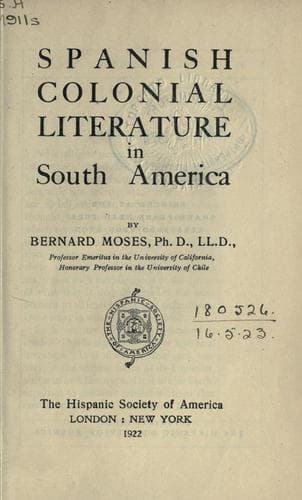
Spanish colonial literature in South AmericaMoses, Bernard
History
Spanish colonial literature in South America
Moses, Bernard
Spanish American literature -- History and criticism
The political relations that existed among the Spanish colonies and the
common dependence of the colonies on Spain presumed their possession of
common ideas and purposes; and the writers who appeared in the different
provinces generally observed affairs from a common point of view. The
question of the time of their appearance deserves rather to be considered
than the place of their residence. This is, of course, pre-eminently true
of writers who were ecclesiastics. The Jesuits of Peru, New Granada, or
Chile, for instance, wrote rather as Jesuits than as citizens of one
province or another. The case of the soldier in this respect was not
greatly different from that of the ecclesiastic, and in the first and
middle period of the colonial history the larger part of the writers who
were not ecclesiastics were soldiers.
[Sidenote: Isolation of the colonies]
[Sidenote: Missions to Spain]
The long intervals between the sailings of vessels from Spain to America,
or from America to Spain, made it extremely difficult for the king and
the Council of the Indies to have correct information concerning the
affairs of the Spanish dependencies. If the colonists wished an unworthy
official removed or legislation reformed, it was necessary to send an
agent to Madrid to enlighten the king and to persuade him to order the
desired change. The difficulties of securing reforms by this method were
very great; the long waiting for the departure of a ship, the weary weeks
of the voyage from Chile around Cape Horn or over the Andes, across
the Argentine plains, and by ship from Buenos Aires, or by way of Peru
and the Isthmus, the interminable delays in obtaining an audience with
the king or the Council of the Indies, the years sometimes spent by
the authorities in reaching a decision regarding the proposition, and
then the similar waiting and delays in securing the transmission of the
decrees to America, in case the question was found to be of sufficient
importance to warrant action by the supreme government. Priests were
often found available for missions of this kind, for various reasons:
they were presumed to be educated persons competent to present a case
before the high authorities; they were supposed to have the confidence
of the king; and it was assumed, in keeping with the rules of their
profession, that they were not encumbered with families, and thus freer
from bonds holding them to any given place than most secular persons. In
the early part of the seventeenth century the Chileans departed from this
practice, and selected a soldier, Alonso González de Nájera, to represent
them before the king.
[Sidenote: Nájera’s _El desengaño y reparo de la guerra del reino de
Chile_]
Public-domain text, read in full here on John Shaqi.
Reviews
Reviews
No reviews yet
Be the first to share your thoughts on this work.
Elsewhere in the archive
Join the Discussion
Join the discussion
Sign in to leave a comment or review.
Sign InorCreate an account