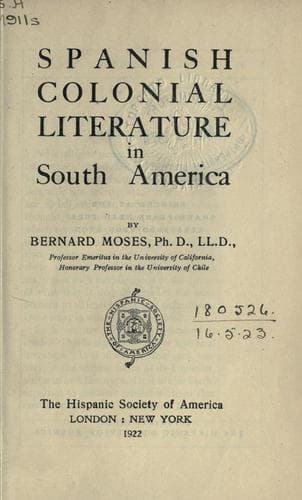
Spanish colonial literature in South AmericaMoses, Bernard
History
Spanish colonial literature in South America
Moses, Bernard
Spanish American literature -- History and criticism
González de Nájera arrived in Chile in 1601, and passed almost
immediately into service on the frontier, to a fort constructed on the
Bio-Bio. He remained five years in this service, and during this period
acquired extensive information concerning the most vital affairs of the
province. In Madrid he rendered to the authorities an account of his
observations and experience, and in this manner set forth the conditions
of society and the government in Chile. From Spain he was sent to Italy
where he completed his work called _El desengaño y reparo de la guerra
del reino de Chile_. Regarding this work he affirms that he has not
written a history as a consecutive narrative, but reasoned opinions and
discourses on the points most essential for the support of the conquest
in the kingdom of Chile.[94]
The title given by Nájera to his writing indicates his opinion that
the directors of Chilean affairs had been deceived, and that he would
undertake to show them their error. He presents a review of the state
of the war, and proposes the means that appear to him most suitable for
terminating it. In inquiring into these means he finds it especially
important that the decree providing for the enslavement of the
Araucanians should be maintained in force. Nájera’s work was finally
published in Madrid, in 1866, in the Volume XLVIII of the _Colección de
documentos inéditos para la historia de España_.[95]
II
[Sidenote: Pineda y Bascuñán]
Among the soldiers of the early part of the seventeenth century who
became writers, Francisco Núñez de Pineda y Bascuñán, a native of Chile,
acquired a position of distinction. He was born in 1607. His father was a
soldier, who for more than forty years was engaged in military campaigns
on the frontier. Francisco’s school years prior to the age of sixteen
were passed in the house of the Jesuits at Arauco. During these years he
received instruction in Latin and such elements of philosophy as were
then given in the schools. At the age of sixteen he left the school and
was given a place in a company of Spanish infantry. In a battle with the
Indians he was severely wounded and captured. During the seven months
of his captivity his amiability and his friendly intercourse with the
Indians immediately in charge of him saved him from the machinations of
those who wished to take his life. He returned to the troops and was
later promoted to the rank of maestre de campo. After his long military
service he found himself in extreme poverty in the last years of his
life. Finally he received from the viceroy an appointment as corregidor
in Peru, where he died in 1682, before he had derived any advantage from
the office that had been conferred upon him.
[Sidenote: _Cautiverio feliz_]
[Sidenote: Quality of Bascuñán’s book]
Public-domain text, read in full here on John Shaqi.
Reviews
Reviews
No reviews yet
Be the first to share your thoughts on this work.
Elsewhere in the archive
Join the Discussion
Join the discussion
Sign in to leave a comment or review.
Sign InorCreate an account