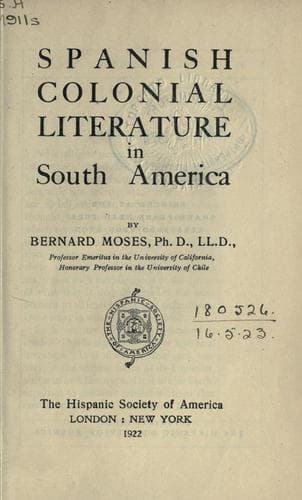
Spanish colonial literature in South AmericaMoses, Bernard
History
Spanish colonial literature in South America
Moses, Bernard
Spanish American literature -- History and criticism
The anxieties of his old age in poverty appear to have been relieved by
his recollection of the kindness he had received at the hands of his
captors, and in this period he wrote of the adventures of his youth,
and of his reflexions on the Spanish military system as applied in
Chile. These were the general topics of his book called _Cautiverio
feliz y razón de las guerras dilatadas de Chile_. This book was “one of
the works most extensively read in Chile and even in Peru during the
colonial period.”[96] It contains a record of the honourable service of
a valiant and faithful soldier, and was rendered especially attractive by
the story of the author’s captivity. But, in keeping with the spirit of
his time, he departed from the plan of a simple narrative and undertook
to impart moral and religious instruction and to make a display of
erudition. This defect is recognized by Medina, who affirms that if the
author had limited himself simply to relating in his admirably simple
and true style the story of his adventures among the Indians of Arauco,
his work would have merited a place in the literature of any of the most
cultivated nations of any time.[97] Still he has been able to give a
dramatic interest to his narrative by keeping alive in the reader’s mind
the inquiry whether Maulicán who promised to secure his escape, or the
caciques who proposed to kill him, will be successful. One of the objects
of the author in writing this book was to set forth the manner in which
the war was conducted in Chile and the fate of those who became victims
of the injustice committed in this war, and at the same time to show
the causes that made the Araucanian war interminable. In this part of
the work he made use of his own experience, revealing by his narrative
the repeated abuses and instances of neglect that contributed to keep
the Indians on a war footing. This feature of the narrative throws an
especially important side light on the Spanish administration of Chilean
affairs.
[Sidenote: The verse in _Cautiverio feliz_]
Throughout the _Cautiverio feliz_ there are various passages in verse,
some of which are translations from the poetical books of the Bible,
or from Virgil, Horace, Ovid, or other poets, or are original verses
written by Bascuñán. Eyzaguirre calls attention to the fact that while
in some of these original verses there are “elevated ideas and a sublime
conception,” in “almost none of them does the author sustain the
elevation of thought to the end,” and cites as an instance the sonnet
to the Virgin on his release from captivity. “At the first glance,” he
writes, “one recognizes the notable difference between the last part,
ordinary and commonplace in its conceptions as well as disagreeable in
its rhythm and the rest of the composition which is certainly beautiful
and majestic.”[98] The following is the sonnet in question (Discurso V,
cap. xiv):
[Sidenote: Illustrative sonnet]
Public-domain text, read in full here on John Shaqi.
Reviews
Reviews
No reviews yet
Be the first to share your thoughts on this work.
Elsewhere in the archive
Join the Discussion
Join the discussion
Sign in to leave a comment or review.
Sign InorCreate an account