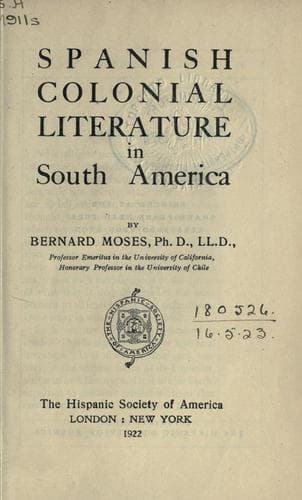
Spanish colonial literature in South AmericaMoses, Bernard
History
Spanish colonial literature in South America
Moses, Bernard
Spanish American literature -- History and criticism
¿Quien hay, Señora, que valerse quiera
De vuestro santo nombre, que no alcance
Con lágrimas orando al primer lance
Lo que imposible al tiempo pareciera?
¿Quién hay que en vuestras manos se pusiera,
Virgen sagrada, en peligroso trance,
Que en el mayor trabajo no descanse,
Y su esperanza fin dichoso adquiera?
Bien manifiesto está en mi larga suerte,
Pues que entre tantos bárbaros contrastes
Quisistéis libertarme de la muerte.
Gracias os doy ya fuera de debates,
Estimando el favor, y si se advierte,
Jamás imaginado entre rescates.
LAUS DEO.
III
[Sidenote: Torres on Sotomayor]
[Sidenote: Torres’ career]
[Sidenote: Soldiers from Lima to Chile]
When Caro de Torres undertook to write his _Relación de los servicios de
Don Alonso de Sotomayor_, he had the advantage of a full knowledge of
his subject. He had long stood in intimate friendly relations with the
governor, and their similarity of inclinations and tastes had established
between them bonds of respect and sympathy. Torres was born in Seville
about the middle of the sixteenth century. His early studies were made
in his native city, whence he passed to the University of Salamanca.
From the university, which he left prematurely owing to a quarrel with
other students, he entered the army, served in Italy under the Marqués
de Santa Cruz, and in 1583 under the same leader played a gallant part
in the campaign of the Azores. Two years later he was in Seville,
where Viceroy Torres was preparing to depart to assume the duties of
his office in Peru. Caro de Torres’ adventurous spirit induced him to
join the expedition. He arrived at Lima on the 30th of November, 1586.
During the period of his military service he found time to acquire
knowledge of Spain’s colonial enterprise in the Indies. The next year
Thomas Cavendish appeared in the Pacific, and Caro de Torres was a
member of the expedition that was sent against him. A few months later
commissioners from Alonso de Sotomayor, the governor of Chile, arrived
in Lima, requesting reinforcements for the defence of the Chilean coast
and for proposed campaigns against the Araucanians. Responding to this
request, the viceroy sent two companies of five hundred soldiers each,
under Luis de Carvajal and Fernando de Córdova. Caro de Torres, with the
rank of captain, was the second in command of one of these companies,
and during this campaign began the long continued friendship between him
and the governor Sotomayor. But shortly after this the soldier of many
adventures entered the order of St. Augustine. The success of Sotomayor’s
military enterprises secured his appointment to the post of governor,
captain-general, and president of the royal audiencia of Panama,
where he was associated with Caro de Torres, and this association was
maintained after Sotomayor returned to Spain. When Sotomayor was about to
die he charged his friend with the duty of watching over the interests
Public-domain text, read in full here on John Shaqi.
Reviews
Reviews
No reviews yet
Be the first to share your thoughts on this work.
Elsewhere in the archive
Join the Discussion
Join the discussion
Sign in to leave a comment or review.
Sign InorCreate an account