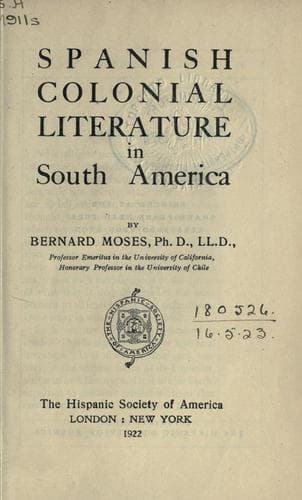
Spanish colonial literature in South AmericaMoses, Bernard
History
Spanish colonial literature in South America
Moses, Bernard
Spanish American literature -- History and criticism
But Ovalle’s experience in the mountains that look down upon the
agreeable valley of Central Chile called him back from his visions of a
fictitious spiritual world, and inspired him to present views of nature
in its most imposing forms. Passing along narrow trails, on the edge of
horrible precipices, descending into the shadows of deep wooded canyons,
in the presence of roaring mountain torrents throwing clouds of mist
into the clear air, his mysticism was for the moment clarified into a
soberer conception of the universal Creator. But ordinarily he was so
profoundly impressed by the wonderful and incomprehensible in nature and
the course of events that he found it apparently impossible to carry on
his narrative without interrupting it here and there to tell the story of
some miraculous manifestation. Montalvo affirms that “he did not know how
to treat of the earth without introducing into his narrative the events
of heaven.”[102]
The excellence of Ovalle’s style doubtless suggested the fitness of his
work for translation; it also persuaded the Royal Spanish Academy to
place it in the list of works quoted for illustration in the Academy’s
_Diccionario de la lengua castellana_.
In 1646 Ovalle was in Rome, attending the sixth general congregation of
the Jesuits, in his capacity as procurador of the vice-province of Chile.
This year he published his _Histórica relación_, which the same year
appeared in an Italian translation. The English translation was first
printed in 1703.
[Sidenote: Ovalle’s last years]
From Rome Ovalle returned to Spain, where he assembled the sixteen
priests who were to accompany him to America. Four years after the
publication of his _Histórica relación_, in 1650, he embarked for Chile
by way of Panama. At Paita, not meeting there the ship he expected
to take him to Callao, he set out overland for Lima, over an almost
trackless region and across the sandy wastes of the desert-like coast
lands, with little preparation for meeting his need of food and water. He
arrived in Lima suffering under a violent fever, from which he died a few
days later.
[Sidenote: Fantastic views of the Scriptures]
Ovalle’s fantastic interpretations of the Scriptures, as witnessed,
among many instances, by his notion that the gold of Ophir was brought
from Peru and Chile by Solomon’s fleet, did not prevent him from writing
clearly and rationally about the events of Chilean history. In the
following paragraph he describes the destruction of Concepción by Lautaro
and his Araucanians:
[Sidenote: Ruin of Concepción]
[Sidenote: Concepción abandoned]
[Sidenote: The city burned]
Public-domain text, read in full here on John Shaqi.
Reviews
Reviews
No reviews yet
Be the first to share your thoughts on this work.
Elsewhere in the archive
Join the Discussion
Join the discussion
Sign in to leave a comment or review.
Sign InorCreate an account