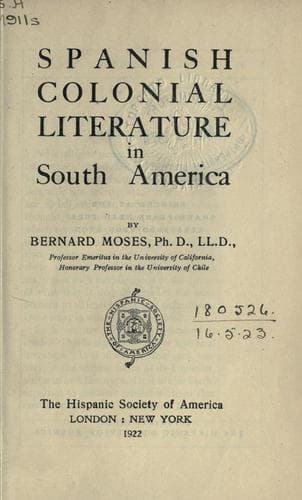
Spanish colonial literature in South AmericaMoses, Bernard
History
Spanish colonial literature in South America
Moses, Bernard
Spanish American literature -- History and criticism
Another teacher and writer of Lima, whose death occurred at Porto Bello
twenty years later than that of Venegas, was Juan de Urquiza. He had been
engaged for twenty-four years in the college of Lima, and during this
period he wrote _Tractatus de profundissima sciencia_ and _Relación de la
fundación de la real audiencia del Cuzco_. The second of these documents
was published in Madrid in 1795.[127]
VIII
[Sidenote: Pedro Simón’s _Noticias_]
[Sidenote: Life of Simón: his journeys]
[Sidenote: Simón on Lope de Aguirre]
An instance of long-delayed publication is offered by that part of Pedro
Simón’s work which now forms the second, third, fourth and fifth volumes
of his _Noticias historiales de las conquistas de Tierra Firme en las
Indias occidentales_, written in the first half of the seventeenth
century and printed in the last decade of the nineteenth century. Simón
was born at Parrilla, near Cuenca, in Spain, in 1574, and began writing
in 1623 at the age of forty-nine. He was educated in the monastery of
San Francisco de Cartagena in Spain, and was sent to South America in
1604 to teach theology and the arts. The early part of Simón’s career
in New Granada thus fell in the long incumbency of President Juan de
Borja (1605-1626), whom he accompanied in the campaign against the
Pijaos Indians. The first part of his _Noticias historiales_ dealt with
the history of the early explorations of the territory now claimed by
Venezuela, and is based largely on information gathered on a journey
through that region. Embarking at Coro, he visited the Antilles, and
returned to Bogotá. Among other places reached in his travels were
Antioquía, Cartagena, and Santa Marta. During these journeys he collected
much of the material for his narrative directly from persons who
participated in the events in question, or who had lived near enough to
them to hear and remember the current tales about them. Other sources
were the writings of Castellanos and a manuscript of Bachiller Francisco
Vásquez. “Indeed page after page of Simón is transcribed word for word
from the manuscript of Vásquez.”[128] Still another source of information
from which Simón may have drawn was Ortiguera’s manuscript account of the
“Expedition down the Marañón” which does not differ essentially from that
of Vásquez. The narration of the events of this expedition constitutes
the most noteworthy section of the first part of Simón’s work. The four
volumes more recently published treat of the discoveries made through the
valley of the Magdalena, together with the discoveries, explorations, and
early history of the regions about Cartagena, Popayán, Antioquía, and
Chocó.[129]
[Sidenote: Death of Lope de Aguirre]
Simón’s account of the death of the bloodthirsty Lope de Aguirre
furnishes an indication of the general characteristics of our author’s
style and a suggestion of the voluminous details of his narratives:[130]
Public-domain text, read in full here on John Shaqi.
Reviews
Reviews
No reviews yet
Be the first to share your thoughts on this work.
Elsewhere in the archive
Join the Discussion
Join the discussion
Sign in to leave a comment or review.
Sign InorCreate an account