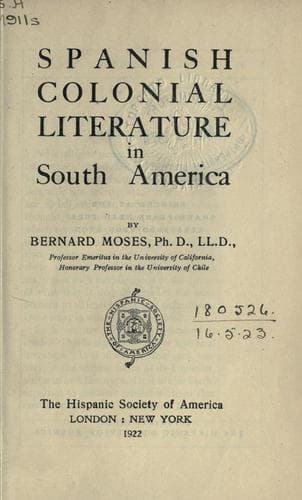
Spanish colonial literature in South AmericaMoses, Bernard
History
Spanish colonial literature in South America
Moses, Bernard
Spanish American literature -- History and criticism
“The maestre del campo, seeing that he had the victory in his own hands,
despatched a mounted messenger to inform the governor and others as to
the satisfactory state of affairs, and then marched straight on Aguirre’s
quarters.
[Sidenote: Aguirre murders his daughter]
[Sidenote: Ledesme scorned by the traitor]
“The traitor, on seeing that he had been abandoned by all except Llamoso,
asked him why he had not gone with the rest, and taken advantage of the
king’s pardon? Llamoso replied that he and Aguirre had been friends in
life, and that he would live or die with him. Aguirre made no reply; he
was crestfallen and lost; he went into an apartment where his daughter
was (who was now a woman) in company with another female, named Tarralva,
of Molina de Aragón in Castile, who had come from Peru in company with
the traitors. She cannot have been of great age, for in 1612 I saw
her (she was then very young) in the city of Barquisimeto. The devil
instigated Aguirre to kill his daughter, so as to crown all his cruel
acts with this most bloody and unnatural one, that of the destruction
of his own flesh and blood. He said to her, ‘Commend thyself to God, my
daughter, for I am about to kill thee, that thou mayest not be pointed at
with scorn, nor be in the power of anyone who may call thee the daughter
of a traitor.’ Torralva tried to save the girl, and even managed to take
the loaded arquebuse from the hands of the father, which he was about to
fire at his victim; but Aguirre had a poniard, and with it he took her
life. Having done this, he rushed to the door of the apartment; but when
he perceived that the king’s forces were upon him, his very hands lost
the power of firing off his arquebuse at them, so as to sell his life
dearly; and, in the most dejected manner, he threw all his arms on the
ground, and went and leant upon a miserable barbacoa or bed place, that
was in the room (opposite that in which he had killed his daughter). One
of the first to enter (before the maestre del campo), was one Ledesme, a
sword-cutler and inhabitant of Tucuyo, who when he saw García de Paredes
enter, thinking to make himself of importance, said, ‘Here I have Aguirre
as my prisoner.’ The traitor replied, ‘I do not give myself up to such a
villain as you,’ and perceiving Paredes, said, ‘Señor maestre del campo,
I beg that you, who are a caballero, will respect my rank, and listen,
for I have many important things to say, for the good of the king’s
service.’
Public-domain text, read in full here on John Shaqi.
Reviews
Reviews
No reviews yet
Be the first to share your thoughts on this work.
Elsewhere in the archive
Join the Discussion
Join the discussion
Sign in to leave a comment or review.
Sign InorCreate an account