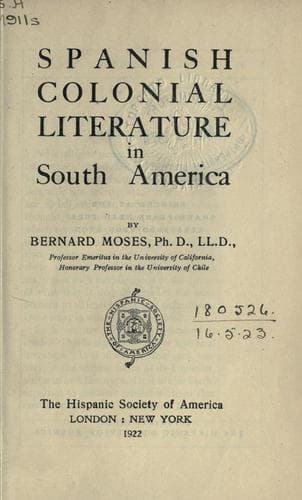
Spanish colonial literature in South AmericaMoses, Bernard
History
Spanish colonial literature in South America
Moses, Bernard
Spanish American literature -- History and criticism
“García de Paredes replied that he should be respected; but some of
Aguirre’s former soldiers, fearing if he were allowed to live it might
go hard with them—for he might reveal what they had done during the
expedition—persuaded the maestre del campo that the best, safest, and
most honourable course was to cut off his head at once, and before the
governor’s arrival. This view of the case was not displeasing to the
maestre del campo, and so he told Aguirre to prepare himself for death,
and commanded two of his own Marañónes to shoot him down with their
arquebuses. This they did at once and the traitor fell dead at their
feet.... A soldier named Custodio Hernández now fell upon the dead body,
and, by order of the maestre del campo, cut the head off and taking hold
of the hair, which was very long, he brought it out to show it to the
governor, who was just arriving thinking to do him honour.”
IX
[Sidenote: Rodríguez Fresle]
[Sidenote: Fresle’s book]
A striking little book of this period, but published later, is _Conquista
y descubrimiento del nuevo reino de Granada_ by Rodríguez Fresle,
sometimes referred to as _El Carnero_. It was written in the first half
of the seventeenth century between April, 1636, and June, 1638, but it
was not printed until 1859. The author was born in Bogotá April 25, 1566.
His father was one of the conquistadores of the country. For a time he
was in the service of Alonso Pérez de Salazar, a judge of the audiencia
of his native city, and he accompanied him to Spain when he was promoted
to be fiscal of the Council of the Indies. His patron died, however,
six months after his appointment, and Rodríguez Fresle was left, as he
said, “como hijo de oidor muerto.” He was left in poverty, and remained
six years in Spain. After his return to New Granada he was engaged in
agriculture, but there appears to be little information extant concerning
the success of his undertakings in this field, or, in fact, concerning
the later years of his life, and the date of his death is unknown. For
a brief period of his later life, beginning the day he completed his
seventieth year, he was occupied in writing his chronicle. Vergara refers
to the author’s style as “natural y correcto, animadísimo a las veces”;
no writer of his time excelled him in the _local flavour which he knew
how to give_ to his lively narrative.[131]
[Sidenote: Garzón de Tahuste]
[Sidenote: _Poema heroico de San Ignacio_]
Public-domain text, read in full here on John Shaqi.
Reviews
Reviews
No reviews yet
Be the first to share your thoughts on this work.
Elsewhere in the archive
Join the Discussion
Join the discussion
Sign in to leave a comment or review.
Sign InorCreate an account