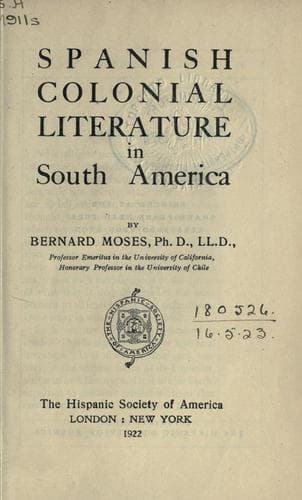
Spanish colonial literature in South AmericaMoses, Bernard
History
Spanish colonial literature in South America
Moses, Bernard
Spanish American literature -- History and criticism
Two works by Alonso Garzón de Tahuste, belonging properly to this
period, were lost as manuscripts. They were _Sucesión de prelados y
jueces seculares del nuevo reino de Granada_ and _Historia antigua de
los Chibchas_. The first of these existed in two copies, one in Madrid,
used by Piedrahita, and the other in Bogotá, used by Zamora. Tahuste was
born at Timaná about 1558, studied in Bogotá, and was for fifty years
Cura Rector of the Cathedral of Bogotá, from 1585. The loss of these and
other manuscripts, many of which would have had very little influence
on the progress of literature, was to a certain extent due to the lack
of facilities for printing in New Granada, and in a measure also to the
neglect suffered by collections of books and papers in periods of social
disturbance. One of the poems of the last half of the seventeenth century
rescued from complete oblivion was the _Poema heroico de San Ignacio_ by
Hernando Domínguez Camargo. It was published in Madrid in 1666, although
not complete. It was written in octave stanzas, but does not rise above
the lower levels of mediocrity.[132]
X
[Sidenote: Quiros’ Voyages]
Interesting narratives of adventure are contained in the third volume of
Pedro Fernández de Quiros’ _Historia del descubrimiento de las regiones
austriales_, edited by Justo Zaragoza (Madrid, 1876). Parts of the
contents of these volumes were published by the Hakluyt Society (London,
1904) in an English translation by Sir Clements Markham, entitled, _The
Voyages of Pedro Fernández de Quiros 1595 to 1606_. One of the most
striking episodes of this work is the story of the dreadful voyage from
the Santa Cruz islands to Manila, setting forth the almost complete
destruction of the ship, the death of Adelantado Mendaña, the accession
of his widow to the chief command, the starvation and death that
exhausted and depleted the crew, and the hungry survivors’ final arrival
in the Philippines. Here they were at first uncertain whether they had
reached a friendly country or that of an enemy, for it had been reported
in Peru, “that Japan was preparing an attack with a great fleet.”[133]
[Sidenote: Half-starved crew in the Philippines]
Public-domain text, read in full here on John Shaqi.
Reviews
Reviews
No reviews yet
Be the first to share your thoughts on this work.
Elsewhere in the archive
Join the Discussion
Join the discussion
Sign in to leave a comment or review.
Sign InorCreate an account