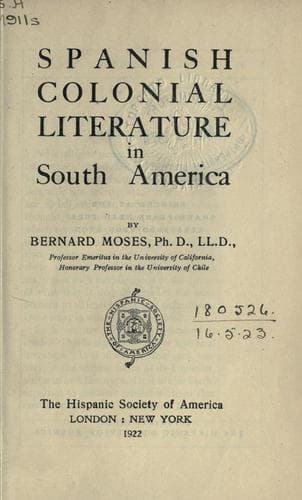
Spanish colonial literature in South AmericaMoses, Bernard
History
Spanish colonial literature in South America
Moses, Bernard
Spanish American literature -- History and criticism
The grandiloquent style that prevailed in Spanish literature and in
Spanish preaching incited the Franciscan friar Martín Velasco, to write
his treatise on Rhetoric under the title, _Arte de sermones_, printed in
Cadiz in 1675. Little is known of Velasco’s life beyond the fact that he
was born in Bogotá, and lived in the Franciscan monastery of that city.
The key to his doctrine appears to be contained in these two sentences:
“Words are smoke and noise which do not go beyond their sense; and in
serving for what they are, it is not they but the truth they utter that
produces the effect. One should try, therefore, to utter much truth in
few words after the manner of the Laconians, and not many words and
little substance.”[144] If the teaching of the inconspicuous friar had
had its merited influence much good might have come to Spanish speech
even out of America.
IV
[Sidenote: Fernández Piedrahita]
[Sidenote: Piedrahita vicar general]
[Sidenote: _Historia de Granada_]
In the last half of the seventeenth century an historian of considerable
merit appeared in the person of Bishop Lucas Fernández Piedrahita,
who was born in Bogotá on March 6, 1624. Through his mother, Catalina
Collantes, he held by birth a more or less distant relationship to a
member of the family of the Incas in Peru. He studied in the Jesuit
college of San Bartolomé, and received the degree of doctor from the
University of Santo Tomás. The literary ambition of his youth manifested
itself in the writing of a number of dramas that are not known to exist.
He was appointed treasurer of the cathedral of Popayán, but before he
entered upon the duties of that office he was made a prebendary of the
metropolitan church in 1654. He was subsequently promoted to various
offices in that church and after the death of Archbishop Torres he was
elected vicar general and governor of the archbishopric; and he continued
to hold the office of vicar general after the arrival of Arguinao, in
1661, the successor of Archbishop Torres. Piedrahita became the favourite
preacher of the city, and through his influence and friendly relation
with the president Dionisio Pérez Manrique, harmony was established
between the ecclesiastical and civil officials. But the arrival of
Cornejo as visitador introduced an element of discord into the community.
Soon after the accession of Arguinao, Piedrahita was called to Spain
to defend himself before the Council of the Indies against charges
preferred by the visitador. His defence was so complete that the Council
not only absolved him from fault, but also offered him the office of
bishop of Santa Marta, and this appointment was immediately confirmed by
the Pope. He remained six years in Spain, from 1663 to 1669, and during
this period he wrote his _Historia general del nuevo reino de Granada_.
[Sidenote: Bishop of Santa Marta and of Panama]
Public-domain text, read in full here on John Shaqi.
Reviews
Reviews
No reviews yet
Be the first to share your thoughts on this work.
Elsewhere in the archive
Join the Discussion
Join the discussion
Sign in to leave a comment or review.
Sign InorCreate an account