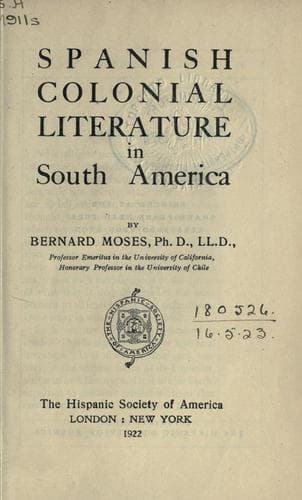
Spanish colonial literature in South AmericaMoses, Bernard
History
Spanish colonial literature in South America
Moses, Bernard
Spanish American literature -- History and criticism
In 1669 Piedrahita returned to America, and after his consecration
entered upon the exercise of his functions as bishop of Santa Marta. Here
he displayed many of the virtues of the primitive Christian teacher,
visited and taught the Indians, distributed his income among the poor and
lived in poverty. His charitable gifts left him hardly means for decent
clothing. In 1676 he was promoted to the see of Panama, but before he
left Santa Marta the town was taken by pirates, who, seeing the meanness
of the bishop’s dress, concluded that by his apparently miserly habits he
must have large accumulations concealed. The pirates, therefore, took
the bishop and tortured him in order to make him reveal the hiding-place
of his treasures; unsuccessful in this, they carried him off and brought
him before the distinguished and courteous pirate Morgan, who received
him with marked consideration, gave him a pontifical robe stolen at
Panama, and caused him to be conducted to his new diocese. Here Bishop
Piedrahita continued for twelve years the devoted life he had led in
Santa Marta, and died at the age of sixty-four. The first part of his
_Historia_ was published in Amsterdam the year of his death, 1688.
According to Vergara, the second part was lost after the death of the
author, since there was no one to care for its publication.[145]
[Sidenote: Piedrahita’s style]
With respect to his style, Piedrahita represents a considerable advance
over the prose writers of South America who preceded him. He wrote
clearly in what might not improperly be called modern Spanish. He had
not, however, freed himself from the custom of his time, or the practice
of writing long and irrelevant introductions to chapters or sections,
the custom that induced the chronicler to begin his narrative with the
creation of the world.
V
[Sidenote: Padre Pedro Claver]
[Sidenote: Slave-trade at Cartagena]
A striking subject for a biography was furnished by the life of Padre
Pedro Claver, who was born in Cataluña in 1585 and died at Cartagena
in 1654. He became a member of the Society of Jesus, entering upon his
novitiate in 1602. For his work among the slaves at Cartagena he became
known as the “Apostle to the Negroes.” Cartagena in the seventeenth
century had a much larger population than at present, and, in relation to
South America, was a much more important port; it was the port at which
were landed most of the ships engaged in the African slave-trade. The
ships arrived overcrowded, with their human freight in an indescribable
condition. The victims of the slave-trader’s greed and inhumanity, in
the long voyage in the tropics, had suffered untold misery from an
insufficient supply of food, air and water, and at the end of the voyage
the living, the moribund, and the dead were found packed in a mass of
filth more foul than anything which the fancy can picture.
Public-domain text, read in full here on John Shaqi.
Reviews
Reviews
No reviews yet
Be the first to share your thoughts on this work.
Elsewhere in the archive
Join the Discussion
Join the discussion
Sign in to leave a comment or review.
Sign InorCreate an account