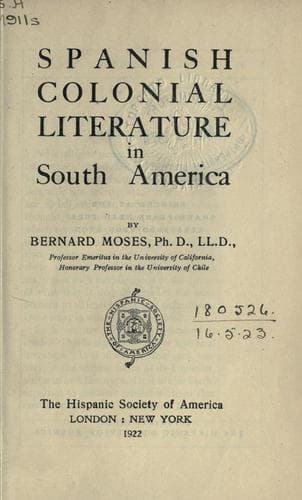
Spanish colonial literature in South AmericaMoses, Bernard
History
Spanish colonial literature in South America
Moses, Bernard
Spanish American literature -- History and criticism
An analysis of Spanish colonial society in South America would reveal
a body of officials composed almost exclusively of men born in Spain,
and educated in accordance with the ideas and traditions of Spain’s
conservative administration. These were the viceroys, the judges of the
audiencias, the royal treasurers, and the corregidores, or governors of
small districts. Hardly less important than the civil officials were the
ecclesiastics, who were sent to the colonies by the authorities in Spain,
and paid out of the royal revenues of the colonies. These members of the
clergy became teachers, missionaries, and parish priests, many of whom
were friars belonging to the various religious orders. A third group was
composed of soldiers, who were sent from Spain for a period of four or
five years, and a more or less extensive body of militia. This military
force was employed in putting down insurrections, defending the frontiers
and extending the dominion of the Spaniards. And it was in this group
that a number of the most noteworthy writers of South America appeared.
Some of the officials, in the exercise of their practically irresponsible
authority, often made illegitimate appropriations from the public funds
that passed under their control; and the parish priests, in many cases,
and the petty governors almost universally, extorted whatever was to be
had from the Indians by a systematic process of merciless oppression.
[Sidenote: The Creoles]
[Sidenote: Social stagnation]
The dishonesty of officials, coupled with the fact that they were almost
exclusively Spaniards, sent from Spain to occupy their posts for a few
years, at length alienated the sympathies of the creoles and the mestizos
from the Spanish administration. The creoles, persons of pure Spanish
blood born in America, in many cases took advantage of the instruction
offered in the colonial universities, and in some instances continued
their studies in Spain. They became men of cultivation and sober
judgment; they knew the circumstances and needs of the society of which
they were members; they had a patriotic interest and an instinctive pride
in their communities or commonwealths; yet they were practically barred
from office, and their advice was seldom, or never, solicited. By this
egoistical and stupid conduct of the government in Spain the creoles and
the mestizos were thrown into an attitude of opposition; a rigid line was
drawn between them and the Spaniards; and on the American side of this
line the creoles and mestizos formed a new society which increased in
numbers and self-confidence with the passing decades. Finally, these two
classes, merged into one and supported by the civilized Indians, asserted
their determination to abolish Spanish domination and be independent.
But throughout the two centuries and a half of colonial existence, under
the influence of Spanish conservatism, the colonies remained, to a very
great extent, in a state of social stagnation until near the end of the
Public-domain text, read in full here on John Shaqi.
Reviews
Reviews
No reviews yet
Be the first to share your thoughts on this work.
Join the Discussion
Join the discussion
Sign in to leave a comment or review.
Sign InorCreate an account