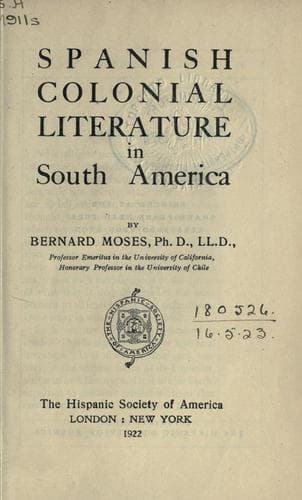
Spanish colonial literature in South AmericaMoses, Bernard
History
Spanish colonial literature in South America
Moses, Bernard
Spanish American literature -- History and criticism
Lima at this time, the beginning of the eighteenth century, had about
seventy thousand inhabitants, Europeans, mestizos, Indians, and negro
slaves. Gold and silver flowed into the city from the mines, and the
buildings that were constructed after the earthquake of 1687 were
superior to those which had been destroyed; they gave Lima an appearance
of prosperity; they suggested a degree of luxury that had not been
evident earlier. The creoles, always fond of display, sought to avoid
the simplicity and rudeness of the smaller towns. They made their wealth
conspicuous by their possession of paintings from Italy and Spain, by
their extravagant dress, and by their abundant ornaments of gold,
pearls, diamonds, and other precious stones; and it is said that the
nobles of Lima exceeded in luxury the aristocracy of Spain. The Peruvian
capital was enlivened not only by the presence of the fifteen hundred
students of the University of San Marcos, but also by a large number of
convents or monasteries, in which the conflicts attending the elections
of their officers often ran so high that large sections of the population
became involved, and the secular authorities were called upon forcefully
to interfere.
Bogotá, Caracas, Quito, Santiago, Asunción, and Buenos Aires were
capitals, like Lima, but on a smaller scale. Common fundamental
characteristics prevailed in all, except as these were modified by the
different material interests and opportunities of the several cities.
In the very small towns and in the country the Indians and the mestizos
predominated, suggesting barbarism rather than civilization.
[Sidenote: Colonial society]
The colonial society of Spanish South America had no notion of social or
political equality like that entertained by the British colonists in
North America, and consequently recognized marked class distinctions as a
phase of the normal social order. The authorities in Spain, charged with
the government of the colonies, maintained the traditional view of social
inequality, and encouraged its practical development by creating a titled
nobility and conferring upon encomenderos a status of superiority over
their dependents not greatly unlike the relation of superior and inferior
that prevailed during the period of European feudalism. Under this social
order the subdued Indians became an element, naturally a subordinate
element, in the composite society of the colonies, instead of drifting
into irreconcilable hostility to Europeans, as happened in British North
America.
[Sidenote: Groups and classes]
Public-domain text, read in full here on John Shaqi.
Reviews
Reviews
No reviews yet
Be the first to share your thoughts on this work.
Join the Discussion
Join the discussion
Sign in to leave a comment or review.
Sign InorCreate an account