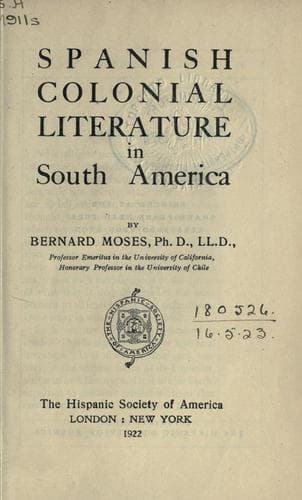
Spanish colonial literature in South AmericaMoses, Bernard
History
Spanish colonial literature in South America
Moses, Bernard
Spanish American literature -- History and criticism
Among the Indians of the Llanos the Jesuits undertook to carry out a
plan of missionary effort similar to that carried out in Paraguay. The
region was divided into a number of districts, or partidos, the partido
of Casanare, that of the Orinoco, and that of the Meta. These were under
the general government of a procurador, who was under the superior
direction of the provincial appointed at Rome to govern the province of
Bogotá. During his term of three years the provincial was required to
visit the missions at least once, or to send an inspector bearing the
title of vice-provincial, who was commissioned to inquire into the state
of the missions and to examine their records and accounts. In the last
decades of the seventeenth century and later the government supported at
each mission a small number of soldiers to assist the missionaries and
to ward off hostile attacks. The success of these missions depended upon
the establishment of such conditions that they would be economically
independent, and for this purpose the missions became proprietors of
extensive herds.
[Sidenote: Rivero’s _Historia de las misiones_]
[Sidenote: Rivero as a missionary]
Juan Rivero’s _Historia de las misiones de los llanos de Casanare y
los ríos Orinoco y Meta_, written in 1736, is an important source of
information concerning the history of these missions. It was printed in
Bogotá in 1883, after it had remained in manuscript about one hundred
and fifty years. The author was born in Miraflores de la Sierra, in
Spain, August 15, 1681. He entered the Society of Jesus as a youth, and
was sent to Bogotá in 1704. He began his missionary work at Tunja, but,
on account of illness caused by the low temperature of the plateau, he
was transferred to the college at Honda and later to that at Mompox.
He was still moved by a desire for missionary work among the Indians,
and, therefore, petitioned his superiors to send him to the Llanos.
His petition was granted, and in 1720 he set out for the plains of
Casanare. He became exceptionally proficient in a knowledge of the Indian
languages, which he was able to make use of in the confessional and in
preaching. He held vigorously to the opinion that the Indians could be
readily induced to adopt the faith of the Church, and that this act would
transform them into civilized men and women. Like many of his countrymen
and later workers for social betterment, he was a single-force reformer.
[Sidenote: Cassani and Gumilla]
Public-domain text, read in full here on John Shaqi.
Reviews
Reviews
No reviews yet
Be the first to share your thoughts on this work.
Elsewhere in the archive
Join the Discussion
Join the discussion
Sign in to leave a comment or review.
Sign InorCreate an account