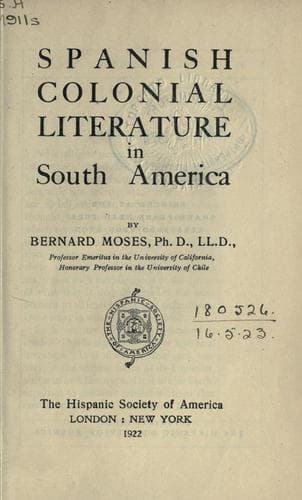
Spanish colonial literature in South AmericaMoses, Bernard
History
Spanish colonial literature in South America
Moses, Bernard
Spanish American literature -- History and criticism
Other writers took up the subject that had engaged the attention of
Rivero and wrote of the region of the Orinoco. Padre José Cassani,
writing of the missions, used Rivero’s manuscript extensively, making it
the basis of his work. Cassani’s _Historia de la Provincia de la Compañía
de Jesús del Nuevo Reino de Granada_ is uncritical and disfigured by
marvellous credulity. It was published in 1741. Gumilla’s _El Orinoco
ilustrado_ was also published in 1741, and a second edition was issued
in 1745. On the title-page of his book Gumilla describes himself as a
“member of the Society of Jesus, missionary, superior of the missions of
the Orinoco, Meta, and Casanare, calificador and consultor of the Holy
Tribunal of the Inquisition of Cartagena of the Indies, synodal examiner
of the bishopric of Cartagena, some time provincial of the province of
New Granada, and actual procurador of the missions and the provinces.”
The title-page furnishes, moreover, a sufficient account of the contents
of the book: “Natural, civil, and geographical history of this great
river, and of its abundant tributaries; government, uses, and customs
of the Indians, with new and useful accounts of animals, trees, fruits,
oils, resins, herbs, and medical roots.”
VI
[Sidenote: Torres’ _Crónica de la provincia peruana_]
[Sidenote: _Tesoros de las Indias_]
[Sidenote: Nicolás de la Rosa]
Each of the religious orders had its chronicler, whose writings
necessarily involved more or less extensive accounts of the secular
events of the societies in which they were established. Bernardo Torres,
an Augustinian, secretary of the province of Lima, prior of the monastery
of Chuquisaca, and sometime professor in the University of San Marcos,
wrote the _Crónica de la provincia peruana_, in eight books, which was
published in Lima in 1657. A continuation of this work in two volumes,
extending to the year 1721, was written by Padre Juan Teodoro Vásquez.
The Dominican Antonio de Aguiar wrote the history of the Dominicans.
Domingo Marín, in his _Estado de los misiones en Chile_, undertook to
defend the Jesuits against their detractors. The Dominican, Meléndez,
set forth the achievements of his order in _Tesoros verdaderos de las
Indias_. The Franciscan, Francisco Javier Ramírez, following a suggestion
from Aguiar, magnified the services of the Franciscans in the _Cronicón
sacro-imperial de Chile_. The _Floresta de la santa iglesia Catedral de
Santa Marta_, by Ensign José Nicolás de la Rosa, derives its historical
data from the writings of Piedrahita, Simón, and Zamora and certain
documents from the cathedral. In addition to the topics suggested by the
title, it contains items of information concerning the Indians inhabiting
the region about Santa Marta. In spite of its indifferent literary
quality and “pésimo gusto literario,” it has been twice printed, once in
1756 and again in 1833. After 1767 ecclesiastical writers in the colonies
Public-domain text, read in full here on John Shaqi.
Reviews
Reviews
No reviews yet
Be the first to share your thoughts on this work.
Elsewhere in the archive
Join the Discussion
Join the discussion
Sign in to leave a comment or review.
Sign InorCreate an account