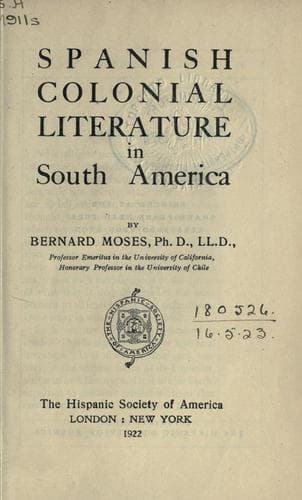
Spanish colonial literature in South AmericaMoses, Bernard
History
Spanish colonial literature in South America
Moses, Bernard
Spanish American literature -- History and criticism
“Emperor Charles the Fifth, having received the news of the death of
James Mendoza, and the ill success of affairs at the river of Plate, and
being of a spirit that ever struggled against adversity, he resolved
to send thither another governor, with a supply of planters. Several
aspiring to the command, Alvar Núñez Cabeça de Vaca carried it, on
account of the great merits of his ancestors. For his grandfather, Peter
de Vera, had subdued the Canary islands for King Ferdinand, and governed
them; in which employment he behaved himself with such integrity, that
having spent his own estate, he was reduced to such distress, that he
gave his two sons in pawn to a Moor, for a sum of money to support his
dignity and maintain his government, and the king afterwards redeemed
them. One of these was father to Alvar we now speak of; who being in
his youth educated in his father’s and grandfather’s virtues, going
over into Florida under Pamphilo de Narvaez, to be the king’s treasurer
there, was shipwrecked on the coast of America, and fell into the
hands of the Indians; and authors of the first rank tell us, he was
so virtuous, that during his ten years captivity among the people, he
wrought several miracles, invoking the blessed trinity. This man being
appointed governor, embarked seven hundred men besides women and children
upon five ships, and sailing from Cadiz with a fair wind, when he came to
twenty-eight degrees of south latitude, landed in that part of America
with five hundred men, and sending the women and children with the rest
by sea, travelled himself by land, almost the same way Alexius García had
gone before, for three hundred leagues, discovering the country and, in
the year 1541, happily arrived at the city of Asunción, and what is most
remarkable, he lost not one soul in all that voyage and journey by sea
and land.”[163]
[Sidenote: Views of the common man]
It is noteworthy that some of the most striking accounts of exploration
in Spanish America were written by common soldiers. Bernal Díaz del
Castillo, Cieza de León, and Ulrich Schmidel are instances. They
interpreted the thoughts and sentiments of the subordinate class, and
help one to see how the private soldier or the common man viewed the
enterprises in which he was engaged. The position of men of this class
made a sharp contrast between their writings and the writings of leaders.
Schmidel’s narrative of his twenty years in America was written in
German, but in its Spanish translation it has been naturalized in the
region of which he wrote, and in which he spent the effective years of
his life.[164]
[Sidenote: Ulrich Schmidel]
[Sidenote: Mendoza’s Expedition]
Public-domain text, read in full here on John Shaqi.
Reviews
Reviews
No reviews yet
Be the first to share your thoughts on this work.
Elsewhere in the archive
Join the Discussion
Join the discussion
Sign in to leave a comment or review.
Sign InorCreate an account