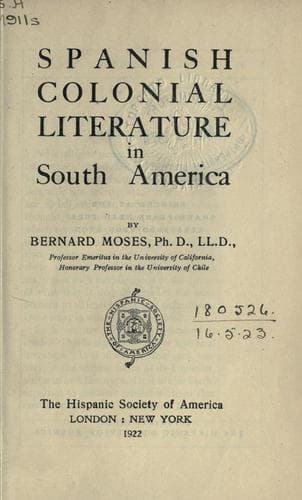
Spanish colonial literature in South AmericaMoses, Bernard
History
Spanish colonial literature in South America
Moses, Bernard
Spanish American literature -- History and criticism
The mediæval tradition that the Church was the supreme patron of learning
was generally recognized in Latin America throughout the greater part
of the colonial period. Men of scholarly tastes and aspirations found
their greatest opportunities in ecclesiastical office, or as members of a
religious order, and many of those who attained the dignity of a bishop
became noteworthy also for their writings. One of the early names in this
list was that of Bishop Lizárraga, whose family name was Baltasar de
Obando. When he assumed the habit of the order of Santo Domingo in 1560,
he became Fray Reginaldo Lizárraga. He went from Spain to Lima with his
parents; thence to Quito among the first European settlers; and finally
he returned to Lima. He was living in Chuquisaca when Viceroy Francisco
de Toledo (1569-1581), committed the crime of taking the life of Tupac
Amarú and of furthering the extermination of the other members of the
Inca family.
From the post of prior he was appointed provincial of the newly-created
province in Chile. After Lizárraga’s service as provincial, he was for
a brief period a missionary in the valley of Jauja, and while there he
received notice of his presentation as bishop of Imperial. This office
had come to him through Viceroy García Hurtado de Mendoza’s (1590-1596)
recommendation to Philip II. The king’s letter of appointment was written
on June 7, 1597, and on June 12 one year later, Lizárraga replied,
accepting the offered dignity. His consecration was delayed until October
24, 1599.
[Sidenote: State of Chile]
[Sidenote: Lizárraga in Chile]
Public-domain text, read in full here on John Shaqi.
Reviews
Reviews
No reviews yet
Be the first to share your thoughts on this work.
Elsewhere in the archive
Join the Discussion
Join the discussion
Sign in to leave a comment or review.
Sign InorCreate an account