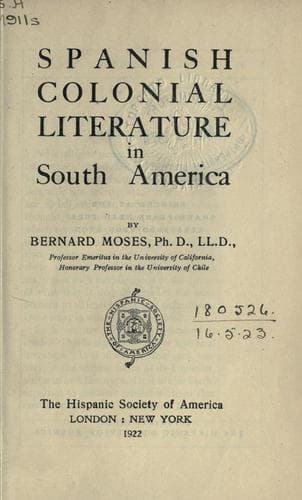
Spanish colonial literature in South AmericaMoses, Bernard
History
Spanish colonial literature in South America
Moses, Bernard
Spanish American literature -- History and criticism
This was not an auspicious moment to be looking towards southern Chile
as a place of residence. The Araucanian war had assumed an unfavourable
aspect; Governor Loyola was dead; the Indians had organized a general
insurrection, and had laid siege to the towns in the diocese of Imperial.
The destruction wrought in this uprising and various other considerations
induced the bishop to hesitate to take up his episcopal duties. In May,
1602, he was still in Lima, but he arrived in Chile in December of that
year, or in January, 1603, thus between five and six years after his
appointment. The ruined condition of Imperial led to the removal of the
see to Concepción; and, in view of the discouraging prospect, the bishop,
a few weeks after his arrival, sent his resignation to the king, with the
request that it might be forwarded to the Pope. For this act the king
wrote to him a severe rebuke, calling upon him to regard his obligations,
to remain with his church, to mend the state of his diocese, to preserve
it for the Church, and to offer his consolation to his subjects. The
number of Europeans within the limits of the bishop’s jurisdiction was
small, and these for the greater part were poor and discouraged. The
bishop was about as poor as the others, and was obliged to live in a
cell offered him in the Franciscan monastery. Yet he showed zeal and
wisdom in the management of the diocesan affairs; more wisdom and zeal,
it is said, than one had reason to expect, considering the indifference,
hesitation, and timidity he had displayed in Lima. Nevertheless, he was
discontented in his office, and, with its annual revenue of only three
hundred dollars, he was able to maintain neither his church nor himself.
His recommendation, therefore, appears reasonable, that his diocese
should be united with that of Santiago, and he be permitted to return to
the monastery of his order. This plan was, however, not carried out, and
in 1608 he was presented by the king for the bishopric of Paraguay, to
succeed Martín Ignacio de Loyola, who was promoted to be archbishop of
Charcas. At the end of 1607, or at the beginning of 1608 he took final
leave of Chile.
[Sidenote: _Descripción y población de las Indias_]
The greater part of his writings deal with religious subjects. There
was a volume on the Pentateuch, two volumes on places mentioned in the
Scriptures, a volume of sermons, a treatise on the life and eminent
services of Jerónimo Loayza, the first archbishop of Lima. These and
most, if not all, of his religious productions, have remained unpublished.
Public-domain text, read in full here on John Shaqi.
Reviews
Reviews
No reviews yet
Be the first to share your thoughts on this work.
Elsewhere in the archive
Join the Discussion
Join the discussion
Sign in to leave a comment or review.
Sign InorCreate an account