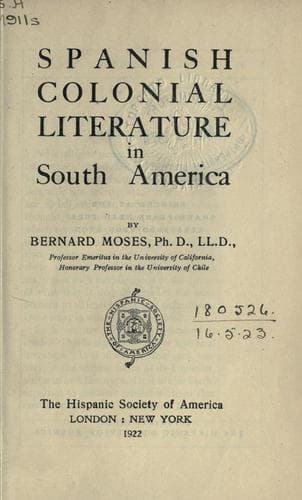
Spanish colonial literature in South AmericaMoses, Bernard
History
Spanish colonial literature in South America
Moses, Bernard
Spanish American literature -- History and criticism
Lizárraga’s most important work was rather secular than religious. It was
called _Descripción y población de las Indias_. Doubt has arisen as to
where this book was written, whether, as indicated in the text, in “the
valley of Jauja,” or in Chile. Medina has discussed the question, and has
reached the conclusion that it was written in Chile, during the second
sojourn of Lizárraga in that country, and from the number of known copies
of it, he infers that it must have enjoyed a certain popularity, if that
may be said of a manuscript necessarily confined to a few readers.[173]
[Sidenote: Contents of Lizárraga’s book]
Among the topics treated in this book are the geography of Chile and
Peru, the viceroys and the governors, the bishops and the provincials,
the territory of Cuyo, and the road over the cordillera. One notes in
this part of it the imposing effect of these mountains with their grand
panoramas and their majestic summits of eternal ice. Lizárraga, like many
other writers, was moved by the grandeur of nature here displayed. At the
same time some of his views suggest the crude faith of his generation.
For instance the appearance of the comet of 1577 he interpreted as an
announcement that God was about to punish the people for their sins, and
that Drake the same year was sent to inflict the punishment.
[Sidenote: Bishop of Paraguay]
As bishop of Paraguay, like the great majority of the priests who
attained episcopal rank in America, Lizárraga led a life of virtue
and devotion. He died at the age of eighty, and the time of his death
accorded with his own prophetic announcement: “a las seis de la tarde iré
a dar cuenta a Dios.”
[Sidenote: _Desengaño del mundo_]
In the last half of the sixteenth century, while the New World was
displaying to Europeans its magnificent scenery and its untold wealth,
there were persons, particularly among the clergy, who, in the midst of
the general hopefulness, assumed to be disillusioned respecting earthly
affairs. Julián Martel’s reflections of this character were set down
in a book entitled _Desengaño del mundo_. He was born in Granada, and
went from Spain to Peru as a member of the secular clergy, but he became
an Augustinian friar, and later rector of the college of his order and
prior at Lima. He was esteemed for his austere life and for his learning,
particularly for his knowledge of Latin and of the writings of the
Fathers of the Church.[174]
II
[Sidenote: Jerónimo de Oré]
[Sidenote: _Símbolo católico indiano_]
Public-domain text, read in full here on John Shaqi.
Reviews
Reviews
No reviews yet
Be the first to share your thoughts on this work.
Elsewhere in the archive
Join the Discussion
Join the discussion
Sign in to leave a comment or review.
Sign InorCreate an account