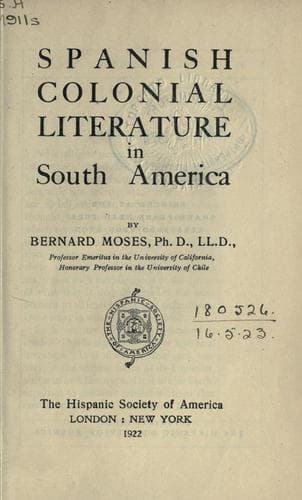
Spanish colonial literature in South AmericaMoses, Bernard
History
Spanish colonial literature in South America
Moses, Bernard
Spanish American literature -- History and criticism
Two especially prominent writers among the ecclesiastics of the first
half of the seventeenth century were Luis Jerónimo de Oré and Gaspar de
Villarroel. Oré was the successor of bishop Lizárraga in the diocese of
Imperial. During the first period of his active life he was a zealous
missionary among the Indians; later he was in Spain and Italy, where
he appears as a writer; and this activity was followed by a period of
devotion to his duties as bishop of Imperial. He was born in Guamanga,
Peru, in 1554, and was the third of the four sons of Antonio de Oré, who,
besides these sons, was blessed with three daughters. He entered the
order of the Franciscans at Lima, and here won distinction through his
studies. His work called _Símbolo católico indiano_ was published at Lima
in 1598. It contains the matter of two distinct books, the first treating
of the mysteries of the Catholic faith, “a philosophico-theological
treatise on God and his attributes,” in a word, “the dogmas of the
Catholic church;” the second being a description of the New World and its
native inhabitants. Like certain later writers Oré would have the name of
the continent derived from Columbus instead of from Amerigo Vespucci.
[Sidenote: _Relación de los mártires_]
[Sidenote: _Rituale seu manuale peruanum_]
Shortly after publishing his _Símbolo católico indiano_ Oré went to
Spain, and in 1604 published, in quarto, _Relación de los mártires que
ha habido en la Florida_.[175] From Spain he passed to Italy, and in
Rome published a treatise on Indulgences, written in Latin. Three years
later, in Naples, was issued his _Rituale seu manuale peruanum_[176]
which contains the prayers and forms of the Roman ritual in Latin and
in Spanish, together with translations into Quichua, Aymará, and other
Indian languages. It was designed to govern the priests and missionaries
to the Indians in the administration of the sacraments, and to guide
them in giving instruction in Christian doctrine. On account of its
translation of the Roman ritual into the Indian languages of South
America, this work is of special importance for the study of these
languages.
[Sidenote: Garcilaso to Oré]
Public-domain text, read in full here on John Shaqi.
Reviews
Reviews
No reviews yet
Be the first to share your thoughts on this work.
Elsewhere in the archive
Join the Discussion
Join the discussion
Sign in to leave a comment or review.
Sign InorCreate an account