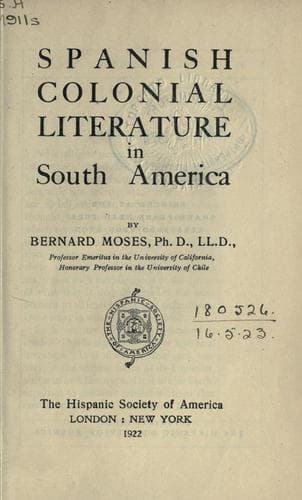
Spanish colonial literature in South AmericaMoses, Bernard
History
Spanish colonial literature in South America
Moses, Bernard
Spanish American literature -- History and criticism
In 1612 Oré visited Garcilaso de la Vega in Córdoba, and Garcilaso
has given an account of this visit in his _Historia general del Perú_
(Madrid, 1722, II, 460): “He told me that in the Franciscan monastery in
Lima there were deposited five heads, that of Gonzalo Pizarro, that of
Francisco de Carvajal, that of Hernández Girón, and two others which he
could not identify; that that religious house had them on deposit, not
buried, but in keeping; and that he desired very much to know which of
them was that of Francisco de Carvajal, on account of the great renown
he had left in that kingdom. I said to him that he might know which of
them was Carvajal’s by the inscription there was on the iron cage; but
he informed me that they were not in iron cages, but free, each one by
itself, without any sign by which it could be identified.
[Sidenote: Oré and the priests for Florida]
“This monk, Luis Jerónimo de Oré, was going from Madrid to Cadiz, under
orders from his superiors and from the Council of the Indies to send two
dozen monks, or to go with them, to the kingdom of Florida, to preach the
gospel to these gentiles. It was not determined whether he would go with
the monks, or return, having despatched them. He requested me to give him
some part of my history of Florida, which those religious might take with
them for their information concerning the provinces and the customs of
the inhabitants. I gave him seven books; three were of the _Florida_, and
four were of our _Comentarios_, for which he acknowledged himself greatly
obliged.”[177]
[Sidenote: Some mystical books]
[Sidenote: Bishop of Imperial]
After his return from Cadiz to Madrid, Oré continued his religious or
mystical writings. Two of his books of this character were _Relación
de la vida y milagros del P. Fr. Francisco Solano_ and _Corona de la
sacratísima Virgen María_. The religious character of his writings had
doubtless much influence in causing him to be presented for the bishopric
of Imperial in Chile in 1620. The appointment by Philip III was
confirmed by Paul V, and near the end of 1620, or in the beginning of
1621, the new bishop arrived in Lima. Oré’s return to his native country,
clothed with literary and ecclesiastical honours, was naturally a source
of supreme satisfaction to his relatives and friends, with whom he spent
nearly two years; and finally, in 1622, he took possession of his church
at Concepción, and entered upon the exercise of his episcopal functions.
He continued to discharge the duties of his high office for a period of
five years, and spent a year of this time among the untamed inhabitants
of Chiloé and the adjacent islands, whom he found less docile than had
formerly appeared to him the Indians of Peru. He died in 1627.[178]
III
[Sidenote: Gaspar de Villarroel]
Public-domain text, read in full here on John Shaqi.
Reviews
Reviews
No reviews yet
Be the first to share your thoughts on this work.
Elsewhere in the archive
Join the Discussion
Join the discussion
Sign in to leave a comment or review.
Sign InorCreate an account