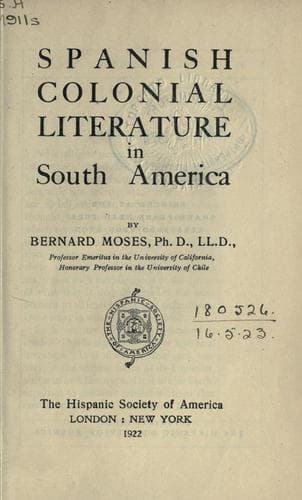
Spanish colonial literature in South AmericaMoses, Bernard
History
Spanish colonial literature in South America
Moses, Bernard
Spanish American literature -- History and criticism
Fray Gaspar de Villarroel, another writer already referred to, was born
in Quito about 1587, of parents who were extremely poor, but who are
said to have descended from a noble family. His father was a lawyer,
and for a certain period was a judge in Cuzco. While his son was still
young, he removed from Quito to Lima in order that the lad might have
the advantage of instruction. In Lima he lived in extreme poverty, but
continued his studies.
[Sidenote: Villarroel in Spain]
The zeal of the father to attain a higher degree of education stimulated
the son to pay special attention to his own cultivation. Like many others
of his time, who would be scholars, Villarroel entered the Church and
assumed the habit of St. Augustine. This was in 1607-1608, and after
this event he turned with new energy to studies in letters and theology.
Later he received the degree of doctor. After a few years his attainments
warranted him in becoming a candidate for a professorship that was vacant
in the university at Lima. His rival, Pedro de Ortega Sotomayor, was
successful, but Villarroel’s candidacy made his merits so well known that
he was elected prior at Cuzco. This office he held until his departure
for Spain, a journey that he made by way of Buenos-Aires.
[Sidenote: _Semana Santa_]
Born and educated in America, Villarroel was unknown in Spain, where
there existed a strong prejudice against all creoles, against their
intellectual attainments, and their fitness for positions in the public
service. To allay this prejudice with reference to himself was one of
the purposes of this journey; and he took with him a manuscript for the
first volume of a work to be entitled _Semana santa, tratado de los
comentarios, dificultades y discursos literates y místicos sobre los
Evangelios de la Cuaresma_. This he caused to be published in Lisbon in
1631 with an adulatory dedication to the king. This work was a commentary
and an interpretation of passages from the Bible, involving much that
appears frivolous, sterile, and commonplace, when considered from the
viewpoint reached after these intervening three hundred years. A second
volume was published in Madrid in 1632, and a third and last volume in
Seville in 1634; in 1626 he published a commentary on the Book of Judges.
This was written in Latin, and contained an abundance of extracts from
the Scriptures and from the Fathers of the Church.
[Sidenote: Appreciation by the court]
Public-domain text, read in full here on John Shaqi.
Reviews
Reviews
No reviews yet
Be the first to share your thoughts on this work.
Elsewhere in the archive
Join the Discussion
Join the discussion
Sign in to leave a comment or review.
Sign InorCreate an account