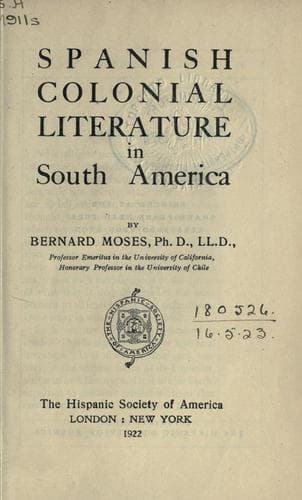
Spanish colonial literature in South AmericaMoses, Bernard
History
Spanish colonial literature in South America
Moses, Bernard
Spanish American literature -- History and criticism
These publications gave evidence of his spirit and his learning; they
made an impression on influential persons at the court; and García de
Haro, after he had heard him preach, became his enthusiastic champion.
Moreover, the court and other persons of distinction conceived an
especially favourable opinion of Villarroel; he was frequently called to
preach before the king and the Council of the Indies; the fashionable
applauded him; and the poetasters wrote verses in his honour. The
practical result of all this for Villarroel was his presentation in 1637,
after a residence of eight years in Madrid, as the bishop of Santiago. He
was consecrated the next year in his monastery in Lima.
[Sidenote: Villarroel’s pastoral influence]
In its isolation the limited society of Santiago, like other colonial
communities, was afflicted with social antagonisms. There was rivalry
between the civil and ecclesiastical officials, and the task that
devolved upon Bishop Villarroel was to establish and preserve a just
balance between the conflicting parties. This task he appears to have
performed with marked success. Herrera, the historian of Ecuadorian
literature, affirms that “he made himself not only notable among the
bishops of America for his wisdom, but also for his eminent virtues
and for his indefatigable zeal in the exercise of his pastoral
functions.”[179]
Villarroel’s benevolence and charity found ample opportunity for exercise
in the afflicted community of Santiago after the earthquake of May 13,
1647, when the earth is said to have trembled and fluctuated like the
sea. The shock caused a terrifying noise, threw down the houses and
churches, and killed six hundred persons in the ruins.
[Sidenote: _Gobierno eclesiástico pacífico_]
_Gobierno eclesiástico pacífico_, Villarroel’s most important work, was
written during his incumbency as bishop of Santiago. It was originally
published in 1656-7, and in 1737 Padre Francisco Vásquez de Sandoval
caused a new edition to be issued. This book treats of the prerogatives
and duties of holders of ecclesiastical and civil office. In it the
author makes manifest his desire for harmony and conciliation, and shows
that no opposition exists between the legitimate designs of the church
and the state. It is not possible to describe this treatise in terms
applicable to a modern work on government. It has the character of a
voluminous mediæval book, containing much that is relevant to the general
subject and much more that from the modern point of view is irrelevant.
It is interspersed with numerous and extensive quotations, and is
crowded with references to both pagan and Christian authors. According
to tradition, these two massive volumes were written within a period of
six months, but they were not published until ten years later than the
date assigned as that of their completion, and there are various reasons
for believing that the work of composition occupied at least some part of
these intervening years.[180]
Public-domain text, read in full here on John Shaqi.
Reviews
Reviews
No reviews yet
Be the first to share your thoughts on this work.
Elsewhere in the archive
Join the Discussion
Join the discussion
Sign in to leave a comment or review.
Sign InorCreate an account