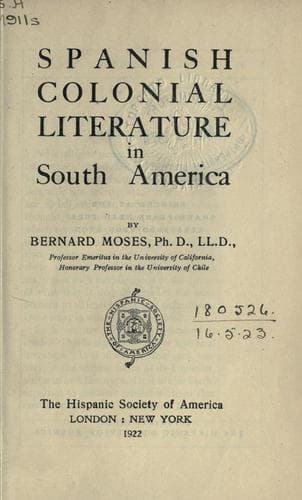
Spanish colonial literature in South AmericaMoses, Bernard
History
Spanish colonial literature in South America
Moses, Bernard
Spanish American literature -- History and criticism
The extension of the Spanish occupation from Santo Domingo, as an early
seat of the administration, to the South American mainland, belongs
to the first decades of the sixteenth century. During this period the
Spaniards founded Santa Marta and Cartagena; explored and occupied the
Isthmus; and Andagoya established his brief authority on the Pacific
coast south of Panama.
[Sidenote: Occupation of Tierra Firme]
[Sidenote: Indians under the British and the Spanish]
It was in this period, moreover, that the Spanish government granted to
the German company of the Welsers a charter to an extensive region of
Tierra Firme, where the agents of this company devoted their activity,
almost exclusively to hunting Indians for the slave-market. On a part
of the northern coast of South America Bartolomé de las Casas proposed
to plant a proletariat colonial administration as the beginning of a
practical reform of Spain’s colonial policy. When this enterprise was
wrecked by its internal weakness, Las Casas turned to the business of
the Church and to unsparing criticism of the Spanish government. On
its practical side the conduct of the government doubtless required
modification, but the plan to introduce Spanish labourers and negroes
to perform all the work of the colony, if it had been thoroughly and
successfully carried out, would indeed have lifted the burden of labour
from the Indians, but it would also have made it impossible for the
Indians to have a place in the new society. The performance of a certain
amount of work was an essential condition of the Indian’s existence in
regions occupied by the Spaniards. He had to work or disappear, as he
disappeared before the British settlers in North America, who made no
provision for incorporating him in the communities which they organized.
The Spaniards had a very different plan for the social development
of their American colonies. They proposed to form communities with
important mediæval features; they recognized distinct classes and feudal
superiority and dependence. This method of social organization provided
a place for the Indians, although a subordinate place, nevertheless a
place where their continued existence would be assured on condition of
performing a certain amount of labour. But when Las Casas faced the
question of reforming the Spanish policy, he appears to have advocated,
if not the worst possible solution, at least a project that could have
had no happy outcome for the Indians.
[Sidenote: Las Casas]
Public-domain text, read in full here on John Shaqi.
Reviews
Reviews
No reviews yet
Be the first to share your thoughts on this work.
Join the Discussion
Join the discussion
Sign in to leave a comment or review.
Sign InorCreate an account