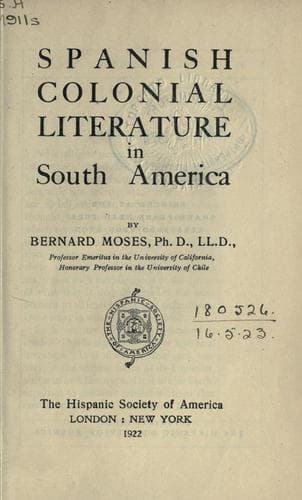
Spanish colonial literature in South America — John Shaqi
Spanish colonial literature in South AmericaMoses, Bernard
History
Spanish colonial literature in South America
Moses, Bernard
Spanish American literature -- History and criticism
The facts of Las Casas’ life hardly need to be recited here. His
prodigious defence of the Indian’s right to liberty has made him widely
known and given him an exalted position in the estimation of those in
sympathy with his purposes. He was born in Seville about eighteen years
before the discovery of America: the date of his birth is usually set
down as 1474. His studies, begun in his native city, were continued at
Salamanca, where he was graduated as “Licenciado”. His first knowledge
of the Indians appears to have been obtained through one who had been
brought from America to Spain by his father, and was attached to
Bartolomé at the University in the capacity of a servant. Las Casas went
to the West Indies with Nicolás de Obando, governor of Santo Domingo.
This was in 1502. In 1510 he became a priest, and a year later he
accompanied Governor Velásquez to Cuba. In these nine years he witnessed
certain acts of barbarity by the Spaniards, which seemed to presage the
diminution of the native population, and intensified his sympathy for
the oppressed race.
[Sidenote: _Brevísima relación_]
In the islands, on the mainland, or as Bishop of Chiapas, one dominating
purpose controlled his actions, it was to ameliorate the condition of the
Indians, and, in planning for their welfare, the welfare of no other race
mattered. Las Casas’ ideal of the Indians, which helped to inspire his
zeal for their liberty is set forth in this passage from the _Brevísima
relación_:
“All the territory that has been discovered down to the year forty-one
is full of people, like a hive of bees, so that it seems as though
God had placed all, or the greater part, of the entire human race, in
these countries. God has created all these numberless peoples to be
the simplest, without malice or duplicity, the most obedient, the most
faithful to their natural Lords, and to the Christians, whom they serve,
the most humble and patient, the most peaceful and calm, without strife
or tumults, nor wrangling or querulous, as free from rancour, hate, and
desire for revenge as any in the world. They are likewise the most
delicate people, weak and of feeble constitution, and they are less able
than any other to bear fatigue, and they succumb readily to whatever
disease attacks them, so that not even the sons of our princes or nobles,
brought up in luxury and effeminate ways, are weaker than they; although
there are among them some who belong to the class of labourers. They are
also very poor people, who have few worldly goods, nor wish to possess
them.”
[Illustration: Bartolomé de Las Casas]
[Sidenote: Las Casas and Liberty]
Public-domain text, read in full here on John Shaqi.
Reviews
Reviews
No reviews yet
Be the first to share your thoughts on this work.
Join the Discussion
Join the discussion
Sign in to leave a comment or review.
Sign InorCreate an account