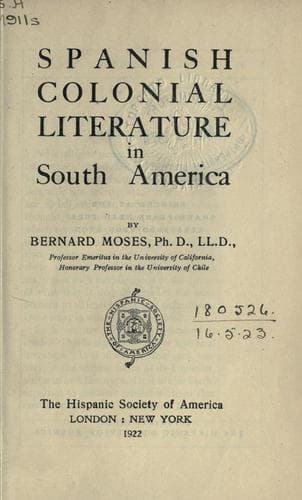
Spanish colonial literature in South AmericaMoses, Bernard
History
Spanish colonial literature in South America
Moses, Bernard
Spanish American literature -- History and criticism
The autocratic government under which the Spanish colonists in America
lived exercised a notable influence on the opinions and theories held
by colonial writers on politics in the seventeenth and the early part
of the eighteenth century; but in the later decades of the eighteenth
century the new creole-mestizo society, or party, revolted against
the hitherto current political philosophy and accepted doctrines that
had found expression particularly in the United States and in France.
While the government of the Spanish-American dependencies was in process
of development, many persons very naturally became interested in the
new laws and the gradual growth of the system. As new phases of the
organization appeared, new questions arose that attracted attention. In
the British colonies, where provision was made for a large measure of
popular local control, interest in governmental affairs found expression
in addresses, projects of law, and debates in popular meetings and
legislative assemblies, and through the still more popular exponent
of opinion furnished by the public press. In the enjoyment of these
facilities, there was almost no incentive to write or publish formal
treatises on political subjects. The Spanish colonies, on the other hand,
presented a very different state of affairs. The people had no voice
in the colonial government; the popular orator, except in the pulpit,
did not exist; there were no legislative assemblies; the viceroys,
the governors, the judges of the audiencia, and the corregidores were
appointed by the king or by the Council of the Indies acting for the
king; only the municipal council, when not dominated by a superior
authority, stood as a feeble representative of the people. The laws under
which the colonists were governed were framed and issued by the king
and the Council, who ruled autocratically through officials rendered
practically absolute by their distance from the supreme head of the state
and by the difficulties and the infrequency of the communication. Any
discussion of current political or governmental questions had, therefore,
to take the form of a treatise, a report, or a petition to the king or
the Council of the Indies. During the greater part of the colonial period
no facilities for publication existed except in Lima, the city of Mexico,
and Spain; for no printing presses existed in Spanish America, except in
these two capitals and certain Jesuit houses, until the last part of the
eighteenth century; and until the last decade of that century there was
no periodical in the South American dependencies through which public
questions might be discussed.
[Sidenote: Question of Chilean Indians]
Public-domain text, read in full here on John Shaqi.
Reviews
Reviews
No reviews yet
Be the first to share your thoughts on this work.
Elsewhere in the archive
Join the Discussion
Join the discussion
Sign in to leave a comment or review.
Sign InorCreate an account