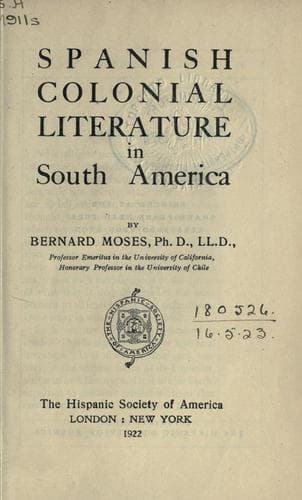
Spanish colonial literature in South AmericaMoses, Bernard
History
Spanish colonial literature in South America
Moses, Bernard
Spanish American literature -- History and criticism
The question as to what disposition should be made of Chilean
Indians captured in war with the Spaniards was raised very early and
continued under discussion for many decades. This was the subject of a
treatise[190] by Melchor Calderón, who went from Spain to Chile in 1555,
and who became a canon and the treasurer of the cathedral of Santiago de
Chile, later a commissary of the Inquisition and vicar-general of the
bishopric. In 1579 he was appointed a member of the cabildo of Santiago.
His book, published late in his life, in 1607, was designed to bring to
the attention of the viceroy the views of the more competent colonists
concerning the advisability of enslaving the rebellious Araucanians.
Calderón’s argument was that since the conquerors were able to kill the
Indians, it would be carrying out a more humane policy to enslave them.
[Sidenote: Diversity of opinions]
[Sidenote: Francisco Falcón]
[Sidenote: Critical view of policy]
There was a wide diversity of opinions concerning the treatment the
Indians ought to receive at the hands of the government. The severe
policy, supported by the encomenderos and the bulk of the secular
authorities, was generally opposed by the members of the clergy; but now
and then a secular writer appeared as the vigorous advocate of a just
and righteous treatment of the Indians. Such an advocate was Francisco
Falcón, who was a lawyer in Lima during the last part of the sixteenth
century. At the ecclesiastical council of Lima, of 1582, Falcón set
out with great force and freedom, verified instances of injustice,
oppression, and robbery by the Spaniards, and urged the council to take
remedial measures and to suppress with a firm hand “those detestable
excesses.” He raised the question of the right of conquest, and denied
that the Spaniards had any such right, or any reason to make war on the
natives. He declared that the encomiendas had been awarded only for such
a period as the emperor might wish to have them continued, and that
whatever these kingdoms produce for the king should be spent for the
Indians themselves, since there was no law allowing the removal of the
revenues from these kingdoms to supply the needs of other countries,
and before all the king should satisfy the needs of those by whom the
production is effected. Falcón maintained, moreover, that no more towns
of Spaniards should have been founded than were necessary “to support
and furnish a backing for the preachers of the gospel.” He condemned the
establishment of towns in regions already cultivated by the Indians. He
opposed the exaction of a tribute from the Indians greater than that
which they had paid to the Incas; at the same time he emphasized the fact
that the revenues collected by the Incas were expended in the kingdom,
and not sent to a foreign country.[191]
[Sidenote: Francisco Carrasco]
Public-domain text, read in full here on John Shaqi.
Reviews
Reviews
No reviews yet
Be the first to share your thoughts on this work.
Elsewhere in the archive
Join the Discussion
Join the discussion
Sign in to leave a comment or review.
Sign InorCreate an account