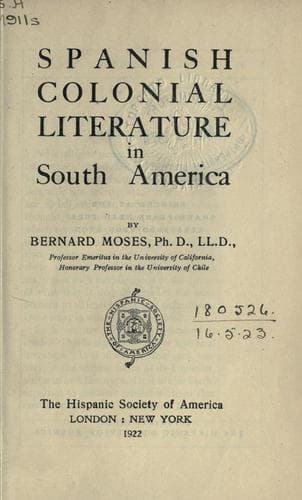
Spanish colonial literature in South AmericaMoses, Bernard
History
Spanish colonial literature in South America
Moses, Bernard
Spanish American literature -- History and criticism
Another phase of the Indian problem was taken up by Dr. Francisco
Carrasco de Saz.[192] He discussed extensively the payment of tithes
by the Indians, and reached the conclusion that they should make this
payment. For the legal aspects of this question he was fitted by his
broad knowledge of law. In the practice of his profession in Lima he
acquired the reputation of being one of the ablest and most distinguished
lawyers of his time. He was rector of the University of San Marcos in
1613, and became fiscal of the royal tribunal called the Crusada. Later
he went to Panama as oidor, or judge, of the audiencia.
II
The judges, or oidores, of the audiencia were usually men of legal
knowledge. Nicolás Polanco de Santillana was a member of the audiencia of
Chile about the middle of the seventeenth century. He was in Santiago at
the time of the earthquake of 1647,[193] and, prompted by the questions
that arose concerning the attitude the government should assume in the
presence of such a disaster, he wrote _De las obligaciones de los jueces
y gobernadores en los casos fortuitos_, beginning and completing his book
while the city still lay in ruins about him. Polanco de Santillana is
accredited also with _Comentario a las leyes del título primero del libro
primero de la recopilación_; but both of these works appear to have been
lost. A colleague and contemporary of Polanco de Santillana, Machado de
Chávez, wrote _Discurso políticos y reformación del derecho_, and this
also has disappeared.
[Sidenote: Matienzo]
[Sidenote: _Gobierno del Perú_]
Three especially important works on politics in the colonies are
Matienzo’s _Gobierno del Perú_, Solórzano’s _Política indiana_, and
Escalona’s _Gazofilacio real del reino del Perú_. These are treatises
on government and law, dealing with the institutions and offices
through which the administration of the dependencies was carried on,
and describing the powers and processes of the civil and military
organization. Matienzo’s book is the earliest of these; it was written
prior to 1573, while the author was a judge of the audiencia of Charcas.
The two parts of the manuscript constituting this volume found their
way into the British Museum, and remained unpublished until 1910, when
they appeared in print under the auspices of the Faculty of Philosophy
and Letters of Buenos Aires. The volume was edited by Dr. José Nicolás
Matienzo, a descendant of the author. It forms an important addition
to the printed sources of knowledge relating to the early history and
organization of the Spanish dependencies in South America. The first part
treats almost exclusively of the Indians under the Incas and in their
subsequent relation to the Spaniards; while the second part treats of the
Spaniards and of the governmental institutions established by them in
America.
[Sidenote: Matienzo’s views]
Public-domain text, read in full here on John Shaqi.
Reviews
Reviews
No reviews yet
Be the first to share your thoughts on this work.
Elsewhere in the archive
Join the Discussion
Join the discussion
Sign in to leave a comment or review.
Sign InorCreate an account