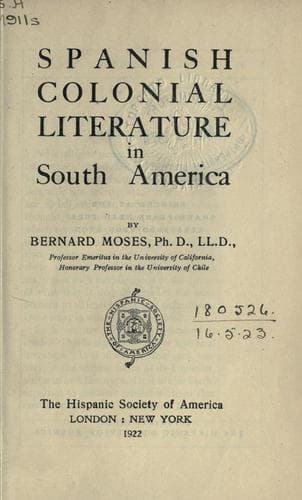
Spanish colonial literature in South AmericaMoses, Bernard
History
Spanish colonial literature in South America
Moses, Bernard
Spanish American literature -- History and criticism
Matienzo affirms the justice of the Spanish conquest, and some of the
grounds of his opinion are, that the Spaniards had received a concession
from the pope; that they found America not occupied by any civilized
power; that the Indians did not wish to receive the Catholic faith;
and that by this act the Indians were relieved from the tyranny of the
Incas. This point having been settled to the apparent satisfaction of the
author, he passed to the consideration of the various classes of the
Indians, classes indicated by the relation they are made to hold to the
Spaniards, and by the tribute they are required to pay. In justification
of the position of the encomenderos, who became the notorious oppressors
of the Indians, it is asserted that when Indians were assigned to
encomenderos the principal purpose was that “they might, with greater
facility, be taught our holy Catholic faith” (Cap. XIV).
After a detailed statement of the status of the Indians under the Laws of
the Indies Matienzo devotes the second half of his volume to an extensive
examination of the organization and operations of the government
established by the Spaniards in Peru, thus giving to the whole treatise
the character of a legal and historical exposition, of importance not
merely for its analysis of the laws and customs prevailing in the Spanish
colonies of South America in the sixteenth century, but also for its
presentation of the views entertained by a judge of the audiencia, and,
presumably, of other high secular officials.
[Sidenote: Audiencias]
The audiencia was not only a supreme court, but also a high
administrative body. In the vacancy of the viceregal office the audiencia
conducted the government in the interim. To increase the efficiency of
the administration, audiencias were established in certain provincial
capitals. In the fully developed colonial organization, there were,
in South America, audiencias in Panama, Bogotá, Quito, Lima, Charcas,
Caracas, Buenos Aires, and Santiago de Chile. Concerning the creation of
the audiencia, of which he was a member, Matienzo wrote:
[Sidenote: _Gobierno del Perú_ quoted]
Public-domain text, read in full here on John Shaqi.
Reviews
Reviews
No reviews yet
Be the first to share your thoughts on this work.
Elsewhere in the archive
Join the Discussion
Join the discussion
Sign in to leave a comment or review.
Sign InorCreate an account