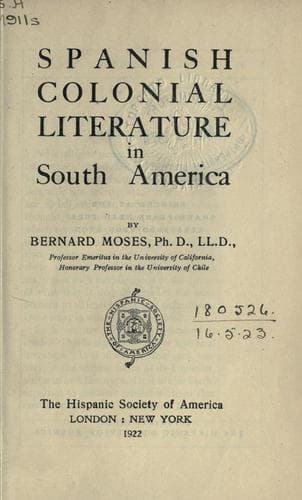
Spanish colonial literature in South AmericaMoses, Bernard
History
Spanish colonial literature in South America
Moses, Bernard
Spanish American literature -- History and criticism
“I promised to write a description of Lima, but the visitador told me
that was an undertaking, in which many men of superior talents had not
been able to succeed, and that it would be ridiculous for a pigmy to
undertake it. But, Señor Inspector, is it possible that I must conclude
such a detailed itinerary without saying anything about Lima? Certainly,
Señor Inca, for this great city does not concern you, is not your affair,
and here ends my commission. Señores Jorge Juan, Antonio Ulloa, he added,
and the principal cosmographer of the kingdom, Dr. Cosme Bueno, wrote
with a swan’s quill of all the most important things in this capital,
and you cannot add anything material with yours which is the quill of a
goose. Nevertheless, I replied, please tell me what is the difference
between this great city and that of my birth. I suppose Señor Inca, he
answered me, that you are prejudiced in favour of Cuzco, your native
town, and would wish me to say that it is superior in every respect to
Lima, but you are greatly mistaken; for, leaving aside the situation
and the parks, you ought to observe that in this great capital the king
maintains a viceroy with great magnificence and with an allowance
equal to the total revenue of all the great estates of Cuzco. It has
also three bodies of guards supported by the king, one of cavalry, well
mounted and paid, others of infantry and halbardiers, which serve not
only for ceremony and ostentation, but also for the protection of the
persons and the peace of this great town. There may be added, moreover,
the audiencia, the superior tribunals of accounts, the inquisition, the
university, the theatre, and the public promenades near the city, which
are not found at Cuzco, or at any other city of the kingdom.
[Sidenote: Carriages, dress, and aristocracy of Lima]
“Lima maintains two hundred and fifty public carriages and more than a
thousand calesas, which are distinguished from the carriages by the fact
that they have two wheels and are drawn by a mule, and are more readily
upset. There is nothing of this kind in your great city. In the matter
of dress, one is as crazy as the other, with a difference of tastes,
and in the extent of families and commerce Lima greatly exceeds Cuzco.
In this city there are many marquises and counts, and a much greater
number of persons who have been decorated with the orders of Santiago and
Calatrava, who with rare exceptions have sufficient incomes to maintain
themselves in splendour, and to whom may be added persons having entailed
estates and gentlemen who are supported by their lands and other proper
kinds of business, so that they may live in a manner to give brilliancy
to the society of the city. There is no doubt that in your native city,
as in others of the vast viceroyalty, there are illustrious families,
but the number of them is not comparable with those of this city” (Chap.
XXVI).
CHAPTER XVII
OUTLOOK TOWARDS EMANCIPATION
Public-domain text, read in full here on John Shaqi.
Reviews
Reviews
No reviews yet
Be the first to share your thoughts on this work.
Elsewhere in the archive
Join the Discussion
Join the discussion
Sign in to leave a comment or review.
Sign InorCreate an account