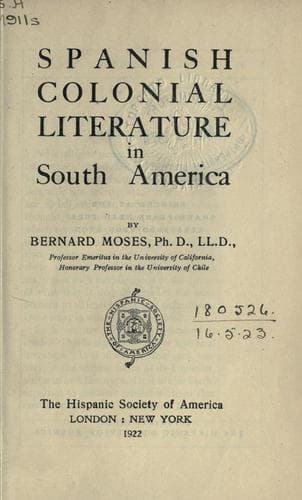
Spanish colonial literature in South AmericaMoses, Bernard
History
Spanish colonial literature in South America
Moses, Bernard
Spanish American literature -- History and criticism
I. _The intellectual movement after the expulsion of the
Jesuits._ II. _Political reformers._ III. _Poets._ IV.
_Literary periodicals: Mercurio Peruano; Gaceta de Lima._
V. _Contributors to Mercurio Peruano._ VI. _El Telégrafo
Mercantil._ VII. _Tadeo Haenke._ VIII. _El Volador._
I
[Sidenote: Expulsion of the Jesuits]
[Sidenote: Signs of new intellectual life]
[Sidenote: The old views and the new]
The expulsion of the Jesuits in 1767 produced an immediate decline
of literary activity in the Spanish colonies. It had, moreover, a
far-reaching influence on the means of instruction; it closed the most
efficient schools, and silenced those persons who might have continued
to spread enlightenment through their writings. The most noteworthy
salvage from the wreck was the collection of books and manuscripts that
were gathered up from the Jesuits’ colleges. In Bogotá some of these
books and papers, placed in charge of a librarian and made accessible in
the building of the ancient Jesuit college, formed what was then known
as the Royal Library. It was formally opened to the public January 9,
1777, and at that time contained 13,800 volumes. Another act tending
to stimulate the intellectual life of New Granada was the organization
of the Botanical Expedition, or bureau of scientific investigation,
under the direction of José Celestino Mutis. A little later literary
production was encouraged by the formation of literary societies, or
“circles,” and the founding of periodicals. The new intellectual movement
appealed particularly to the rising generation of creoles. A phase
of it was seen in the attention given to political questions and the
enthusiastic patriotism manifested by Antonio Nariño and his associates.
But this movement did not close abruptly the period of mediævalism in the
colonies. Writers, like Manuel de Caycedo Ladrón de Guevara (Bogotá,
1718-1781), continued to produce voluminous works which made clear only
the author’s ecclesiastical erudition. But in view of the approaching
revolution in the British colonies and in France, more men began to think
in terms of worldly things; instead of exercising their imaginations in
creating a heavenly state, they began to look forward to a new earthly
state. The new idealism, imposed upon men by the rising spirit of
revolution, contained a force competent to transform the world.
Public-domain text, read in full here on John Shaqi.
Reviews
Reviews
No reviews yet
Be the first to share your thoughts on this work.
Elsewhere in the archive
Join the Discussion
Join the discussion
Sign in to leave a comment or review.
Sign InorCreate an account