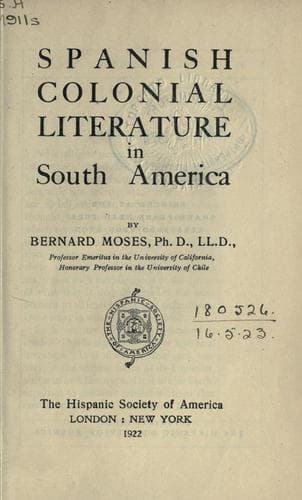
Spanish colonial literature in South AmericaMoses, Bernard
History
Spanish colonial literature in South America
Moses, Bernard
Spanish American literature -- History and criticism
A writer who may be said to have spanned the gulf between the old and
the new order of things was Felipe de Vergara y Caycedo, who was born
in Bogotá on May 20, 1745. He was educated in the college of Rosario,
received there the degree of Doctor, accepted a professorship of
theology, and while holding this position gave instruction also in
mathematics. He visited Spain, carrying letters from the viceroy, the
audiencia, and the archbishop. He returned as contador of Panama, and
later he became contador of the Royal Tribunal of Accounts in Bogotá.
After the Revolution of 1810 he was a member of the Assembly and of the
electoral college of Cundinamarca, and later was secretary and counsellor
of state to President Nariño. He died December 18, 1818. The long list
of his work is evidence not only of his vast erudition but also of his
indefatigable industry.[210]
[Sidenote: Bogotá a centre of reform]
Bogotá as the centre of the intellectual movement in New Granada was
already provided with institutions competent to further this movement.
The University of Santa Fe was under the direction of the Dominicans in
the Dominican monastery. The college and seminary of San Bartolomé had
been for a century and a half under the control of the Jesuits, but after
the expulsion of the Society it was placed in charge of the archbishop.
The college of Rosario, like that of San Bartolomé, was by royal decree
made equal in privileges to the University of Salamanca, the type of the
Spanish university. In these institutions the early curriculum, limited
to Latin, theology and philosophy, was increased by the addition of
courses of instruction in jurisprudence, medicine and mathematics.
[Sidenote: Change in the religious orders]
Throughout the greater part of the colonial period the religious orders
had in many instances been true to their mission as advocates of the
Christian faith. Many of the members had led lives of devotion and
heroism in their efforts to impart to the Indians a new and higher
conception of life. But in the course of time the zeal of their militancy
declined. With the contributions of the faithful they built imposing
edifices and filled them with books and works of art. A few still became
writers, and all, in virtue of the history of their institutions,
continued to hold a high place in the esteem of the public, even when
many of them had fallen into indolence and were leading more or less
useless lives.
[Sidenote: Reaction and Progress]
Public-domain text, read in full here on John Shaqi.
Reviews
Reviews
No reviews yet
Be the first to share your thoughts on this work.
Elsewhere in the archive
Join the Discussion
Join the discussion
Sign in to leave a comment or review.
Sign InorCreate an account