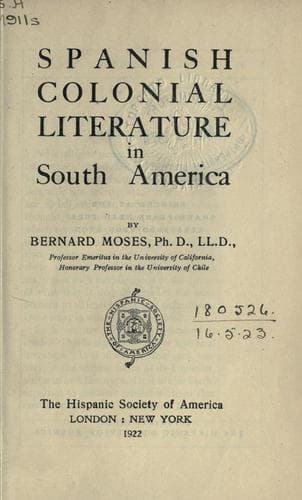
Spanish colonial literature in South AmericaMoses, Bernard
History
Spanish colonial literature in South America
Moses, Bernard
Spanish American literature -- History and criticism
The monasteries, however, in the course of time ceased even to be centres
of historical study. The Dominicans had produced Zamora, the Franciscans
Simón, and the Augustinians San Nicolás, but the orders developed no
successors to these writers; rather, in the presence of the intellectual
awakening, they assumed an attitude of protest and denial. They disputed
the affirmations of Galileo and the conclusions of other scientific
investigators; and thus, with the progress of the inquiries instituted
by Mutis and carried on by his pupils and followers, there appeared a
widening breach between the monasteries, representing mediævalism, and
the investigators of nature, presaging a new day.
[Sidenote: Francisco Antonio Moreno]
It was clear to some minds that in order to make continuous the forces of
intellectual progress it was necessary to reorganize the schools of the
country and to bring them into harmony with the new views of knowledge.
In sympathy with this thought Viceroy Guirior commissioned Francisco
Antonio Moreno to form a new plan of instruction, that would provide not
only for a new curriculum, but also for the establishment of a school
wherever one had been closed by the expulsion of the Jesuits. In the
judgment of the persons most eminent in the affairs of New Granada Moreno
appeared admirably fitted for this undertaking. He was born in Mariquita
on October 25, 1736, and was educated at Bogotá, his studies taking a
somewhat wider range than that provided by the conventional curriculum.
He held in succession various high offices in the viceregal government,
to which he was promoted with the spontaneous support of the viceroy,
the secular cabildo, the university, the archbishop, and the audiencia.
Towards the end of his career he was appointed an oidor, or judge, of the
audiencia at Lima; a little later he was transferred to Chile as regent,
and died at Santiago on February 24, 1792.[211]
[Sidenote: Revolt of the Comuneros]
Public-domain text, read in full here on John Shaqi.
Reviews
Reviews
No reviews yet
Be the first to share your thoughts on this work.
Elsewhere in the archive
Join the Discussion
Join the discussion
Sign in to leave a comment or review.
Sign InorCreate an account