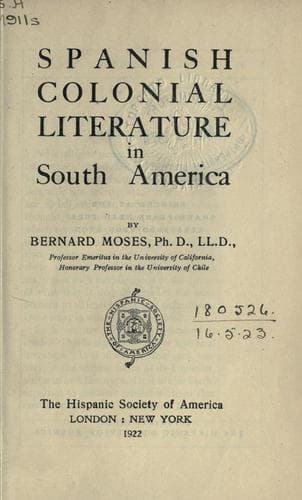
Spanish colonial literature in South AmericaMoses, Bernard
History
Spanish colonial literature in South America
Moses, Bernard
Spanish American literature -- History and criticism
Moreno’s plan received the enthusiastic support of the viceroy and men
of liberal intelligence, like Mutis and Felix Restrepo, and promised
to introduce an enlightened revolution in the field of education, but
when it was brought to the attention of the crown it was disapproved
by the Council of the Indies. The Council held rigorously to the old
plan of instruction, but two years were spent in making the application
for approval and in receiving the reply, and in this period important
steps were taken in the execution of Moreno’s proposed reform. And
finally, when the order of the council arrived, Viceroy Guirior had been
succeeded by Flórez, and Flórez had been shoved into the background by
Visitador Piñeres. Then came the revolt of the Comuneros of 1781, and
the governmental authorities had a mind for no other phase of internal
affairs. In this period, when the government was paralysed, the advocates
of the new plan succeeded in carrying out many of its features; other
persons were converted to its advocacy, and Zea published in the _Papel
periódico_ an article entitled _Hebéfilo_, a vigorous argument against
the old scheme of studies.[212]
II
[Sidenote: Mutis and literary unions]
[Sidenote: Antonio Nariño]
The new intellectual movement expressed itself not only in the
researches directed by Mutis but also in the formation and activity of
literary unions, or “circles.” At the meetings of these circles a great
variety of scientific subjects were discussed. Two persons especially
conspicuous in the decade between 1790 and 1800 were Antonio Nariño
and Francisco Antonio Zea. Nariño was born in Bogotá in 1765, studied
philosophy and jurisprudence in the college of San Bartolomé, and was
appointed treasurer of tithes. Provided with an adequate income and moved
by his zeal for instruction, he collected in his house an extensive
library of books imported from Europe, and the facilities which they
offered for acquiring information attracted about the owner the serious
youths of the city. By diligent use of modern European works Nariño not
only acquired a knowledge of several modern languages, but was also able
to correct the instruction he had received in the college as it was
conducted under its mediæval régime; he also acquired the progressive
ideas of Europe and the British colonies then putting into operation the
independent government of the United States. Inspired by these ideas,
he became a vigorous advocate of liberty and independence, but the
vicissitudes of ill-fortune prevented him from attaining the object of
his early ambition. For printing a Spanish translation of _Les droits
de l’homme_ he was arrested and condemned to imprisonment in Africa. At
Cadiz he escaped, fled to Madrid, visited France and England, and finally
returned to Bogotá. In spite of the good offices of friends, he was again
arrested, and kept in confinement until the revolution of 1810 set him
free.
[Sidenote: Antonio Zea]
[Sidenote: Zea in Spain]
Public-domain text, read in full here on John Shaqi.
Reviews
Reviews
No reviews yet
Be the first to share your thoughts on this work.
Elsewhere in the archive
Join the Discussion
Join the discussion
Sign in to leave a comment or review.
Sign InorCreate an account