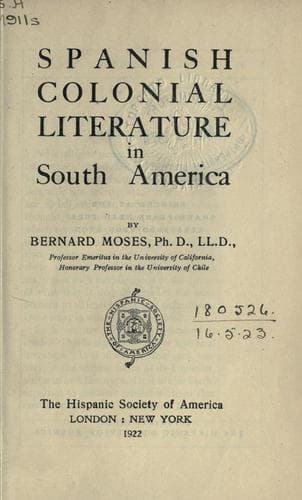
Spanish colonial literature in South AmericaMoses, Bernard
History
Spanish colonial literature in South America
Moses, Bernard
Spanish American literature -- History and criticism
[Sidenote: Zea in Spanish service]
Antonio Zea was sent to Spain as a prisoner with Nariño and the others
who at that time had fallen under the condemnation of the colonial
authorities. He was five years younger than Nariño, having been born
in Medellín in 1770. He received his early instruction in the seminary
of Popayán, and passed from that institution to the college of San
Bartolomé, in Bogotá, where he studied theology and civil law. Through
his association with Mutis, he was introduced to the study of the
inductive sciences. On the withdrawal of Valenzuela from the botanical
expedition, Zea was appointed to the position thus made vacant, with a
salary of five hundred dollars a year. Zea was then nineteen years old,
and for a person so young he had extraordinary attainments. It was after
two years in this service that he was arrested, in 1794, for conspiracy
and sent to Spain. In the long trial to which he was subjected with the
other political offenders, the charges were not sustained. The next three
years he spent in Paris on a scientific mission, receiving a stipend of
twelve hundred dollars a year, the Spanish government being apparently
solicitous that he should not go back to New Granada; for when he sought
permission to return to America, his request was refused and he was
appointed adjunct, and later director, of the botanical collections in
Madrid. In 1805 he was appointed professor of Botany. His residence
in Madrid extended over the years from 1804 to 1807, and during this
period he was elected to membership in various scientific societies,
and wrote a number of memoirs embodying the results of his observations
and studies in New Granada. His scientific studies were interrupted in
1807, when he was drawn into the revolution of Aranjuez. He belonged to
the “afrancesados”, the party in sympathy with French ideas and plans,
and believed that the triumph of this party would be followed by the
emancipation of his country. During the following years he was in the
service of the government, now as director of one of the sections of the
Department of the Interior, and subsequently as prefect of Malaga. He was
occupying this latter post when the Spanish colonies in America struck
for independence.
[Sidenote: _Concordia en discordia_]
[Sidenote: Lagunas’ _Colección legal_]
Public-domain text, read in full here on John Shaqi.
Reviews
Reviews
No reviews yet
Be the first to share your thoughts on this work.
Elsewhere in the archive
Join the Discussion
Join the discussion
Sign in to leave a comment or review.
Sign InorCreate an account