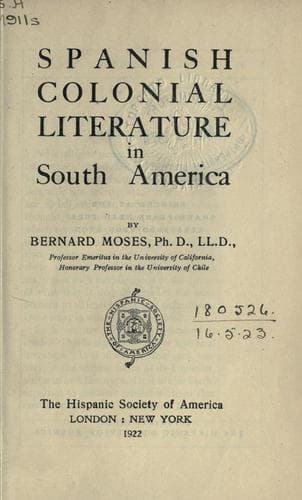
Spanish colonial literature in South AmericaMoses, Bernard
History
Spanish colonial literature in South America
Moses, Bernard
Spanish American literature -- History and criticism
The opposition to various provisions of the Spanish government, which
found expression in revolts and rebellions in the eighteenth century,
occasionally appeared also in writings of that time. The pamphlet called
_Concordia en discordia_, by Alonso de la Cueva Ponce de León, was a
document of this class. It criticized prevailing doctrines, attacked the
royal prerogatives, and argued against many of the recognized rights of
the crown. The author was a native of Lima, became an ecclesiastic, was
appointed vicar-general of the bishopric of Panama, was attorney for the
Inquisition of Cartagena, and became the historian of the archbishopric
of Peru. His criticism of political affairs aroused hostility and, in
consequence of this, as one writer has expressed it, he was “pulverizado”
by the distinguished jurist Pedro José Bravo de Lagunas y Castilla, who,
about the middle of the eighteenth century was a judge of the audiencia
of Lima, and in 1761 published in that city a number of pamphlets under
the general title of _Colección legal_.[213]
III
[Sidenote: José María Gruesso]
[Sidenote: Gruesso’s _Las noches de Geussor_]
Besides the group of political reformers associated with Nariño there
was a society of young men of letters who formed a literary union called
“Eutropélica.” At the head of this company stood Manuel S. Rodríguez.
Among the other members were José María Valdés, Francisco Antonio
Rodríguez and José María Gruesso. As a young man Gruesso prepared himself
for the practice of law. He had finished his legal studies, when the
sudden death of the young woman whom he was about to marry caused him to
change completely his plan of life. Under the influence of this shock he
turned from the legal profession to the Church. He entered the college
of San Bartolomé, and began at once his ecclesiastical studies. Two
years later he returned to Popayán as a priest, and lived there, it is
said, “triste hasta la muerte.” During this period, and while in this
state of mind, he wrote _Las noches de Geussor_ in imitation of Young’s
_Night Thoughts_. The plan of this work provided for thirty cantos, or
nights, but whatever may have been the number written, only three have
been preserved. These are entitled _La soledad_, _La noche_, and _El
remordimiento_.
[Sidenote: Buen Gusto]
[Sidenote: José Fernández de Madrid]
Public-domain text, read in full here on John Shaqi.
Reviews
Reviews
No reviews yet
Be the first to share your thoughts on this work.
Elsewhere in the archive
Join the Discussion
Join the discussion
Sign in to leave a comment or review.
Sign InorCreate an account