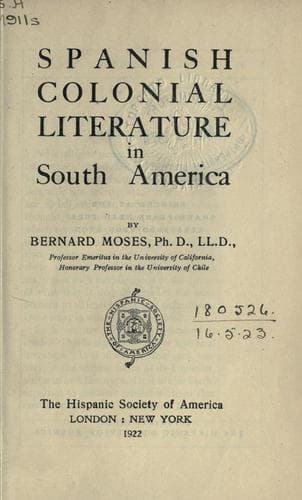
Spanish colonial literature in South AmericaMoses, Bernard
History
Spanish colonial literature in South America
Moses, Bernard
Spanish American literature -- History and criticism
Another group of writers formed a society known as “Buen Gusto.” These
writers were accustomed to meet at the house of Doña Manuela Santamaría
de Manrique, who was esteemed not only for her attainments in literature,
but also for her knowledge of nature. The members of this group were
chiefly poets, born in New Granada, and educated in either the college
of Rosario or the college of San Bartolomé. They wrote, among other
things, certain plays that were presented in the theatre of Bogotá. Two
of these were the _Sacrificio de Idomeneo_ and _El Zagal de Bogotá_.
Perhaps the most widely known of the poets of the Buen Gusto was Dr. José
Fernández de Madrid, whose studies had given him the title of Doctor
of Laws as well as that of Doctor of Medicine. Whether in prose or
verse, the writings of the persons who were thus drawn together in these
associations are rather indications of beginnings in literature than of
a culmination of literary progress. They are not reminiscent of colonial
dependence but premonitory of an emancipated population.
[Sidenote: The poems of Aguirre]
[Sidenote: _La rebelión y caída de Luzbel_]
The poems of Juan Bautista Aguirre are found chiefly in a manuscript
collection called _Versos castellanos, obras juveniles, misceláneas_. The
author was born in Guayaquil, and as a youth was sent to Quito by his
parents to prepare for his career as a man of letters. The university was
then under the control of the Jesuits, and Aguirre accepted membership
in the Society. It is, moreover, reported that he became a lecturer on
philosophy in the university. An elegy on the death of Philip V and an
account of the earthquake of 1746 suggest that he was writing before the
middle of the century. In 1767 he was involved in the general expulsion
of the Jesuits from South America. Later he lived in Rome. His lectures
on philosophy, whether in Quito or Rome, apparently did not turn his
mind from his inclination to write verses, and some part of his writings
indicate that they were produced when religious thoughts and the image
of the Bible were uppermost in his mind. In the _Concepción de Nuestra
Señora_ he is lost in profound mysticism, and in _La rebelión y caída de
Luzbel y sus secuaces_ he is seized by the subject which Milton evidently
found the most inspiring in his great theme, the pride and ambition of
Satan to rule the universe:
Falsear haré con ira fulminante
Del alto cielo en un vaivén ruidoso,
La azul muralla y subiré triunfante
A ser Señor del reino luminoso:
Si son estorbo a mi ímpetu arrogante
Aire, mar, tierra o firmamento hermoso,
Haré que sientan mi furor violento
El mar, la tierra, el aire, el firmamento.
Public-domain text, read in full here on John Shaqi.
Reviews
Reviews
No reviews yet
Be the first to share your thoughts on this work.
Elsewhere in the archive
Join the Discussion
Join the discussion
Sign in to leave a comment or review.
Sign InorCreate an account