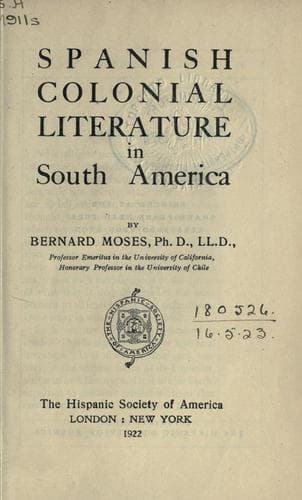
Spanish colonial literature in South AmericaMoses, Bernard
History
Spanish colonial literature in South America
Moses, Bernard
Spanish American literature -- History and criticism
When Aguirre sang of “amores profanos” he may be thought to have gone
beyond the limits of his proper field as a priest, but he took the
precaution, as Gutiérrez remarks, to indicate in a note that if he wrote
erotic verses it was purely for diversion and exercise, and that they
should be considered like the innocent love-talk of Don Quijote with the
impalpable Dulcinea.[214]
[Sidenote: _A una tórtola quejosa_]
An opinion of the quality of Aguirre’s lighter poems may be derived from
his sonnet _A una tórtola quejosa_, which a distinguished critic affirms
embodies the style and sentiment of Petrarch:
Por qué, Tórtola, en cítara doliente
Haces que el aire gima con tu canto?
Si alivios buscas en ajeno llanto
Mi dolor te lo ofrece; aquí detente.
Al verte sola de tu amante ausente
Publicas triste en ayes tu quebranto;
Yo también ¡ay dolor! suspiro tanto
Por no poder gozar mi bien presente.
Pero cese ya ¡oh Tórtola! el gemido,
Que aunque es inmenso tu infeliz desvelo
Mayor sin duda mi tormento ha sido:
Pues tú perdiste un terrenal consuelo
En tu consorte; pero yo he perdido
En mi adorado bien la luz del cielo.
[Sidenote: Later poets]
[Sidenote: _Tucapelina_]
The Chilean poets of the later decades of the colonial period lacked the
inspiration that the writers of the sixteenth century received from the
events of the conquest. They had no longer the spirit that moved Ercilla
to attempt to weave the circumstances and happenings of the Araucanian
war into an epic. The _Cautiverio feliz_, by Francisco Núñez de Pineda
y Bascuñán, the _Restauración de la Imperial_, by Juan de Barrenechea
y Albis, and _Tucapelina_, by a writer who assumed the name of Pancho
Millaleuba, reveal a less exalted vision and purpose than the earlier
writers, less seriousness of thought and a less effective use of the
Spanish language. They drifted towards the expression of subjective
moods, and into giving their verses a distinctly satirical tone. “The
muse of Bascuñán, with philosophico-moral tendencies in sentiment, was
not long in becoming entirely mystical.”[215] The verses of Juan de
Barrenechea y Albis are passed over by the Chilean critic as “in reality
without animation or sentiment,” leaving the writer with no higher rank
than that of a rhymer.[216] The writer of _Tucapelina_ calls his work an
“heroic poem.” It consists of ten divisions called _decadas_, and aims,
among other objects, to represent the changes that had come over the
Araucanian country in the period between the time of Ercilla and the last
half of the eighteenth century, when the inhabitants had ceased to be
rebellious and the sons of caciques were taking advantage of facilities
for education provided by the Spanish government. The critic suggests
that the element of burlesque and satire in the poem may have been one
of the reasons why the author wished to conceal his identity under an
assumed name.
[Sidenote: Padre López and his kind]
Public-domain text, read in full here on John Shaqi.
Reviews
Reviews
No reviews yet
Be the first to share your thoughts on this work.
Elsewhere in the archive
Join the Discussion
Join the discussion
Sign in to leave a comment or review.
Sign InorCreate an account