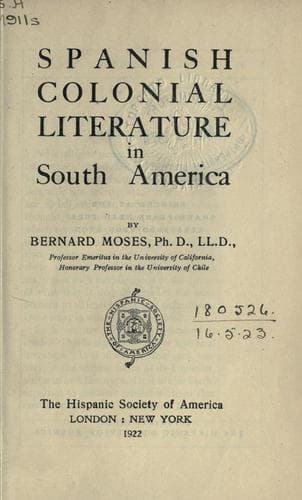
Spanish colonial literature in South AmericaMoses, Bernard
History
Spanish colonial literature in South America
Moses, Bernard
Spanish American literature -- History and criticism
Among other verse-makers who obtained a certain local celebrity Padre
López was especially noted. He was a Dominican friar, and was known
as a wit and an improvisator, but very naturally, having gained this
reputation, many sayings were attributed to him for which he was not
answerable; yet an attempt has been made to attach to him the designation
of the Chilean Quevedo. Most of his productions that have survived are
occasional satirical pieces; in fact, the serious things of life seem not
to have come within the field of his vision. He was a pronounced enemy of
the Jesuits but a welcome participant in meetings pervaded by a spirit
of revelry. Another ecclesiastic, Padre Escudero, a Franciscan, wrote
much in the same vein as Padre López, and showed no more inclination
than López to abide by the regulations that are supposed to control the
conduct of monks.
[Sidenote: Minor poets]
In the last quarter of the eighteenth century appeared a number of poems
narrating events that had made an impression on the public mind. Those
narrating in metrical form the tale of thieves asphyxiated in their
attempt to carry off the treasures of a mine, the death of Bishop Alday,
and the destructive flood of the Mapocho in 1780 are chiefly noteworthy
by reason of having been remembered by the people, thus magnifying and
immortalizing their subjects. There is also manifest at this time a
tendency to invent new forms of verse in which to express commonplace
thoughts. To these late years of the century belong also the satirical
verses of Fernández Ortelano, issued under the title: _Ensalada poética
jocoseria_.[217]
With the spiritual awakening and the extension of education among the
creoles it was to be expected that many persons would essay poetic
flights; still the most important intellectual tendencies were along
political, not poetical, lines. Whatever ideas came from other nations,
from North America or from France, tended to arouse the people to
practical action rather than to stimulate their poetic fancies. The
poets were distinctly minor poets: Jerónimo Hurtado de Mendoza, Antonio
Campusano.
[Sidenote: Ecuadorian poets]
Public-domain text, read in full here on John Shaqi.
Reviews
Reviews
No reviews yet
Be the first to share your thoughts on this work.
Elsewhere in the archive
Join the Discussion
Join the discussion
Sign in to leave a comment or review.
Sign InorCreate an account