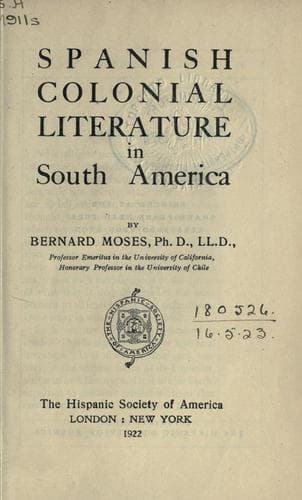
Spanish colonial literature in South AmericaMoses, Bernard
History
Spanish colonial literature in South America
Moses, Bernard
Spanish American literature -- History and criticism
After the death of Prince Juan, on October the fourth, 1497, Oviedo
visited Italy, where the art and literature of that country exerted
a powerful influence on his intellectual development. In 1500, after
three years of varied service, he appeared at Rome, claiming the jubilee
indulgence granted to the faithful by the Pope. Subsequently he entered
the service of the King of Naples, but in 1501 he left Naples in the
train of Queen Juana for Palermo, and in May, 1502, he left Palermo
for Valencia, where he took leave of the Queen’s service and went to
Madrid. In Madrid he married Margarita de Vergara, who died ten months
later. Under the impression of this loss, he turned to service in the
army, but he soon abandoned his plans for a military career, and became
again attached to the court. Shortly after Oviedo’s return to the court,
preparations were made for the expedition of Pedrarias Dávila to Castilla
de Oro, and he was appointed to inspect the production of gold in Tierra
Firme.
[Sidenote: Las Casas and Oviedo as reformers]
The fleet sailed from San Lucar on April 11, 1514, and arrived at Santa
Marta on the following 12th of June. At the end of June the company
reached the gulf of Urabá, and proceeded to Santa María del Antigua,
where they found the colony overwhelmed in misfortune, now rendered
more distressing by the tyranny and cruelty of Pedrarias. Oviedo, out
of favour with the authorities, returned to Spain to seek a remedy
for the state of things he had observed. After years of waiting to
have his memorial considered by the court, he encountered at Barcelona
Bartolomé de las Casas, who was present on a somewhat similar mission.
They both sought reform in the Indies, but with divergent views. Oviedo
contemplated a reform in Darien through the efforts of a wise and just
governor and a bishop devoid of covetousness, who would aim effectively
at holding the clergy under proper regulations. Las Casas, on the
other hand, a religious anarchist, advocated removing the governors,
the captains, and the soldiers from the Indies, agreeing to maintain
the territory of Cumaná in the power of the crown without other
instrumentalities than a few hundred simple labourers and fifty knights
of the cross.
Public-domain text, read in full here on John Shaqi.
Reviews
Reviews
No reviews yet
Be the first to share your thoughts on this work.
Join the Discussion
Join the discussion
Sign in to leave a comment or review.
Sign InorCreate an account