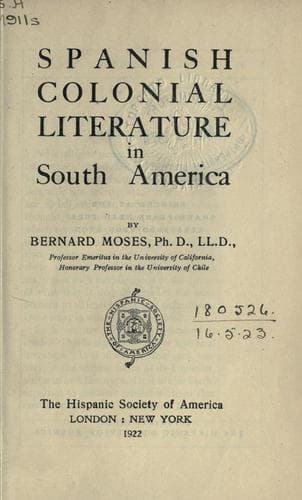
Spanish colonial literature in South AmericaMoses, Bernard
History
Spanish colonial literature in South America
Moses, Bernard
Spanish American literature -- History and criticism
The King and the Council of the Indies, in granting lands to Spaniards
establishing themselves in America, and distributing Indians among them
to become labourers on these lands, had as one of their purposes an end
not greatly different from the object of the missionary’s striving.
They hoped that by gathering the Indians on these estates to make them
immediately subject to Christians who would be required to provide
opportunities and facilities for the Indians to acquire a knowledge of
Christian doctrine. Thus one of the features of the colonial organization
against which Las Casas directed his vehement eloquence was in some part
the product of a design formed to further the conversion of the Indians.
If it did not attain its high aim or respond to the exalted purpose
of Las Casas, it failed for the same reason that some of Las Casas’
plans had failed: it was conceived in imperfect knowledge of American
conditions, and was entrusted for execution to selfish, in other words,
human agents.
II
[Sidenote: Oviedo’s early life]
An attempt less radical than that of Las Casas to improve Spain’s
colonial administration was made by Gonzalo Fernández de Oviedo y Valdés,
author of the _Historia general y natural de las Indias_. Although
Oviedo’s posthumous fame rests almost exclusively on his writings, his
reputation during his lifetime was based chiefly on his practical
activity. A contemporary of Las Casas, he was born in Madrid in 1478, and
very early entered the service of Don Alfonso de Aragón, the second duke
of Villahermosa, a nephew of King Ferdinand. Here his early years were
spent under the influence of persons interested in literary cultivation,
and where the circumstances tended to stimulate his natural intelligence.
At the age of thirteen he became attached to the court of the Catholic
Kings as a page. Two years later the sovereigns entered upon the campaign
against Granada, and Gonzalo followed the Court to Santa Fe. There as a
youth he saw some of Spain’s most distinguished men of the time. He saw
Columbus, whose distinction was yet to be won, and who appeared asking
assistance to enable him to find a new world.
[Sidenote: Oviedo in Italy]
[Sidenote: Joins Pedrarias’ expedition]
Public-domain text, read in full here on John Shaqi.
Reviews
Reviews
No reviews yet
Be the first to share your thoughts on this work.
Join the Discussion
Join the discussion
Sign in to leave a comment or review.
Sign InorCreate an account