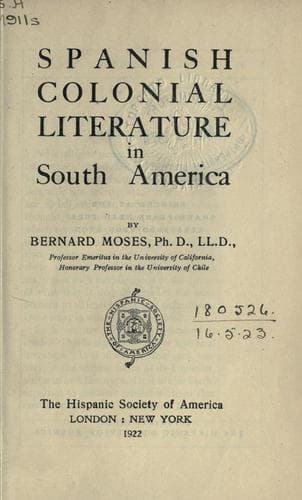
Spanish colonial literature in South AmericaMoses, Bernard
History
Spanish colonial literature in South America
Moses, Bernard
Spanish American literature -- History and criticism
Until the discovery of the Pacific and the voyage along the western
coast, knowledge of America had been only very slowly increased, and in
this process no especially startling statements had been received in
Europe. But reports that an empire had been discovered, that the emperor
had been captured, and that his subjects had offered untold amounts of
gold and silver as his ransom, fired the imagination of the Spaniards
and appealed to their cupidity. After this the business of exploration
and conquest moved with greater rapidity. The number of persons in Spain
wishing to emigrate or to join expeditions bound for the New World
increased, and the settlements already established in the islands lost
a large part of their inhabitants, carried away to Peru by the desire
for adventure and the wealth to be obtained; and the eagerness to get
information from America was greatly intensified. Reports and letters
sent from Peru to satisfy this demand tended to augment the popular
excitement, and in so far as they have been preserved they constitute
an important part of the historical record of Pizarro’s enterprise in
Peru. Those that were directed to the King or the Council of the Indies
concerning the events of the conquest were usually deposited in the
archives, and only a part of them have come to light. Among documents of
this class belong some of the contemporary accounts of the conquest of
Peru. Francisco de Xerés, the writer of such a document, was Pizarro’s
secretary, who left Spain in January, 1530. His account was written in
Peru at the request or by the order of Pizarro. He returned to Spain in
July, 1534, and his report was printed in Seville in that year. Three
years later a second edition was printed in Salamanca. The edition most
frequently referred to is that of 1749. Xerés was an actor in, or a
witness of, the remarkable events which he describes, and his narrative
has the freshness and vividness of a story by one writing of what he
saw. The Hakluyt Society included a translation of it into English in a
volume entitled _Reports on the Discovery of Peru_. This volume contains
also a translation of Hernando Pizarro’s letter to the audiencia of Santo
Domingo. This letter gives a summary of the events of the conquest prior
to November, 1533. There is given here, moreover, a translation of Miguel
de Astete’s report on Hernando Pizarro’s expedition to Pachacamac.[15]
The paragraph describing the capture of Atahualpa may serve as an
illustration of Xerés’ style of narration:
[Sidenote: Capture of Atahualpa]
[Sidenote: Xerés’ story]
Public-domain text, read in full here on John Shaqi.
Reviews
Reviews
No reviews yet
Be the first to share your thoughts on this work.
Join the Discussion
Join the discussion
Sign in to leave a comment or review.
Sign InorCreate an account