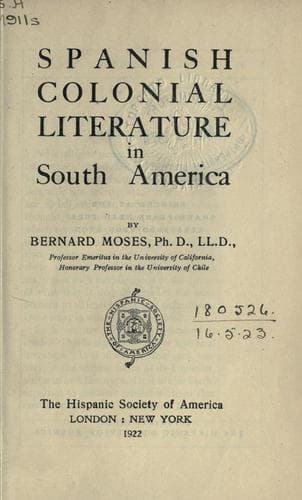
Spanish colonial literature in South AmericaMoses, Bernard
History
Spanish colonial literature in South America
Moses, Bernard
Spanish American literature -- History and criticism
During the conflict between Pizarro and Almagro that resulted in the
death of Almagro, Garcilaso de la Vega was established at Cuzco. Chimpa
Ocllo, a young Indian princess, baptized as Doña Isabel, was living at
Cuzco at that time. She was a granddaughter of Inca Tupac Yupanqui.
Her father was a brother of the distinguished king, Huayna Capac, the
twelfth in the line as given by Cieza de León. She was thus a cousin of
the unfortunate Atahualpa. In 1540 she gave birth to a child who became
the historian, and whose father was Garcilaso de la Vega. The childhood
and youth of the younger Garcilaso was spent in Cuzco, the capital from
which members of his mother’s family had ruled the famous Indian kingdom.
During these early years his father was engaged in the civil wars that
afflicted the unhappy country; at first on the side of Pizarro, and later
taking part in the rebellion led by Gonzalo Pizarro against the first
viceroy of Peru, Blasco Núñez de Vela. One of the earliest recollections
of the historian was the triumphal entry of the forces into Cuzco after
Gonzalo Pizarro had put down his enemies.
Garcilaso de la Vega, the elder, once more changed his allegiance; he
deserted the cause of Gonzalo Pizarro, and fled from Cuzco to Lima. But
the party of the viceroy, which he had hoped to join was overthrown, and
the viceroy had departed.
[Sidenote: Garcilaso at Cuzco]
Although pardoned by Gonzalo Pizarro, Garcilaso de la Vega went over
to the forces of Gasca at the battle of Jaquijaguana in 1548. Between
this event and the rebellion of Girón in 1553 he resided at Cuzco, and
after the failure of this rebellion he was appointed corregidor and
governor of that city and province. As the principal figure in the civil
administration of the province, his house became the centre of the social
activity of the city. Thus in the turmoil and rebellions and the quieter
life that followed, the younger Garcilaso de la Vega, was in a more
favourable position than any other historian had occupied for acquiring
a correct view of the history and institutions of the two races here in
conflict.
[Sidenote: Garcilaso the younger]
A suggestion of the opportunities the young Garcilaso de la Vega enjoyed
for acquiring knowledge of the institutions and spirit of his mother’s
people is found in his statement that while she lived in Cuzco, her
native town, “almost every week some of the male and female relations,
who escaped the cruelty and tyranny of Atahualpa, came to visit her. On
the occasion of these visits their usual conversation was on the subject
of the origin of the Yncas, of their majesty, of the grandeur of their
empire, of their greatness, of their mode of government in peace and
war, and of the laws which they ordained for the good of their subjects.
In short, they omitted nothing relating to the flourishing period of
their history in the course of these conversations.”[34]
[Sidenote: Garcilaso in Spain]
Public-domain text, read in full here on John Shaqi.
Reviews
Reviews
No reviews yet
Be the first to share your thoughts on this work.
Elsewhere in the archive
Join the Discussion
Join the discussion
Sign in to leave a comment or review.
Sign InorCreate an account