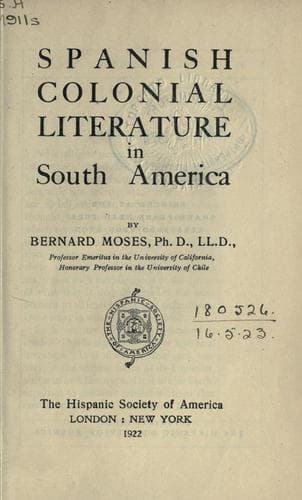
Spanish colonial literature in South AmericaMoses, Bernard
History
Spanish colonial literature in South America
Moses, Bernard
Spanish American literature -- History and criticism
As Garcilaso de la Vega advanced toward maturity, he became his father’s
agent in superintending his estates and acquired much information about
Peru through journeys. After his father’s death he determined to go to
Spain. Here he was received with kindness by his father’s relatives, and
such generosity by others as might be accorded to one born in America. He
entered the army of Philip II as a captain, and took part in the campaign
against the Moriscos under Don Juan de Austria. On his retirement from
active military service, he became a resident of Córdoba, where he was
compelled by his poverty to adopt a very modest style of living. He was
not only in debt when he left the army, but under a certain cloud of
public disfavour by reason of his father’s connexion with Pizarro’s
rebellion. It is quite possible that his consciousness of this prejudice
deepened his piety for his native land and the kingly race from which he
was descended and persuaded him to set forth their virtues and the nobler
qualities of their rule, and not to omit the wrongs they had suffered at
the hands of the Spaniards.
[Sidenote: _Los comentarios reales_]
Garcilaso de la Vega’s principal work is _Los comentarios reales_. This
was based not only on information acquired during his early life at
Cuzco, but also on later contributions made by his former associates in
Peru; for as soon as he decided to write this history, he communicated
with his old schoolfellows and asked them to help him by sending accounts
of the particular conquests which the Incas had made in the provinces of
their families. They took up his project and caused to be brought out
from the archives the accounts which their relatives possessed, and sent
them to him; it was thus, he said, “that I obtained the records of the
deeds and conquests of each Inca.”[35]
The first part of _Los comentarios reales del Perú_ was published at
Lisbon in 1609, and the second part was first published at Córdoba in
1617. The author died in 1617 and was buried in the cathedral of Córdoba.
A second edition was published at Madrid in 1723, and a third edition at
the same place in 1829.[36]
[Sidenote: _La Florida del Inca_]
An earlier work by Garcilaso de la Vega, _La Florida del Inca, historia
del adelantado Hernando de Soto, gobernador y capitán-general del reino
de la Florida, y de otros heroicos caballeros españoles e indios_,
was published in Lisbon in 1605. Written in an agreeable style, it
was received with great favour, and for it the writer would have been
accorded distinction, even if he had not later produced a more important
book. Much of the consideration enjoyed by Garcilaso and the popularity
of his writings were due to the fact that he revealed to Europeans of
his day a hitherto unknown kingdom, and set it before them idealized by
the piety and patriotic emotions of an exile.[37]
[Sidenote: Markham on Garcilaso]
[Sidenote: Garcilaso’s accuracy]
Public-domain text, read in full here on John Shaqi.
Reviews
Reviews
No reviews yet
Be the first to share your thoughts on this work.
Elsewhere in the archive
Join the Discussion
Join the discussion
Sign in to leave a comment or review.
Sign InorCreate an account