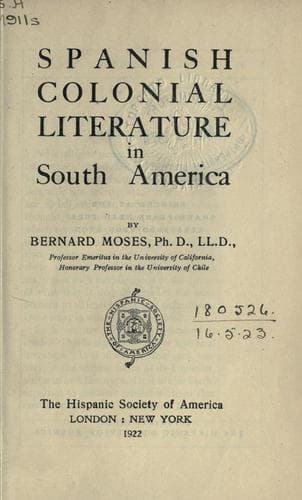
Spanish colonial literature in South AmericaMoses, Bernard
History
Spanish colonial literature in South America
Moses, Bernard
Spanish American literature -- History and criticism
Sir Clements R. Markham, in his introduction to the _Narratives of the
Rites and Laws of the Yncas_, makes this interesting note concerning
Garcilaso’s memory and the accuracy of his statements:
“Garcilaso wrote from memory, forty years after he had left Peru, with
the aid of letters from correspondents. His main object was to publish
a commentary, correcting the errors of Spanish authors who professed to
give a history of the Yncas without being acquainted with their language.
In doing this, he added much precious information from the storehouse of
his own memory, and the more his work is sifted and examined, the more
clearly does it appear that he was scrupulously truthful, and that,
allowing for the disadvantage under which he laboured, his statements
are wonderfully accurate. Perhaps the excellence of the Ynca’s memory
is best shown in the topographical details. He gives the conquests of
each successive Ynca, mentioning the places through which the conquerors
marched in the gradual acquisition of their vast empire. He enumerates
three hundred and twenty places in Peru, yet, in describing the marches,
he does not make a single mistake, nor give one of these places out of
its order, or in the wrong position. When Garcilaso’s routes of each of
the conquering Yncas are placed on a map, they present convincing proofs
of the remarkable accuracy of the author.”
[Sidenote: Prescott on Garcilaso]
Another phase of Garcilaso’s writing is presented by Prescott (_Conquest
of Peru_, I, 469-473), where he affirms that Garcilaso de la Vega
“wrote to effect a particular object. He stood forth as counsel for his
unfortunate countrymen, pleading the cause of that degraded race before
the tribunal of posterity. The exaggerated tone of panegyric consequent
on this becomes apparent in every page of the work. He pictures forth
a state of society, such as an Utopian philosopher would hardly venture
to depict.” His work “is addressed to the imagination more than to sober
reason. We are dazzled by the gorgeous spectacle it perpetually exhibits,
and delighted by the variety of amusing details and animated gossip
sprinkled over its pages. The story of the action is perpetually varied
by discussions on topics illustrating its progress, so as to break up the
monotony of the narrative, and afford an agreeable relief to the reader.
This is true of the first part of his great work. In the second there
was no longer room for such discussion. But he has supplied the place
by garrulous reminiscences, personal anecdotes, incidental adventures,
and a host of trivial details—trivial in the eyes of the pedant—which
historians have been too willing to discard as below the dignity of
history.”
Referring to the edifices constructed at Cuzco by the Indians under the
Incas, Garcilaso de la Vega gives expression to the astonishment which
many persons since his day have experienced:
[Sidenote: Ancient buildings at Cuzco]
Public-domain text, read in full here on John Shaqi.
Reviews
Reviews
No reviews yet
Be the first to share your thoughts on this work.
Elsewhere in the archive
Join the Discussion
Join the discussion
Sign in to leave a comment or review.
Sign InorCreate an account