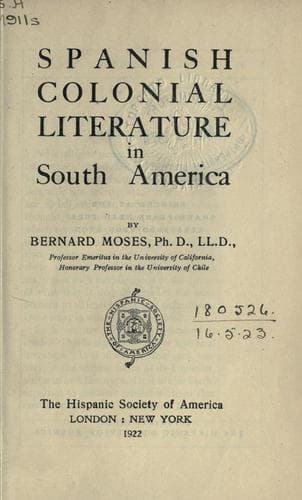
Spanish colonial literature in South AmericaMoses, Bernard
History
Spanish colonial literature in South America
Moses, Bernard
Spanish American literature -- History and criticism
It was first published by the Hakluyt Society in 1873, translated from
the manuscript into English by Sir Clements R. Markham, under the title
of _The Fables and Laws of the Yncas_. It was printed for the first
time in Spanish in 1913, in the fifth volume of the _Revista chilena
de historia y geografía_ preceded by a biography, not of the author,
but of Cristóbal de Molina of Santiago. The edition of 1916, by Romero,
was printed from a copy in the National Library at Lima, which was made
from the manuscript in the National Library at Madrid (E. 13, 135). The
other works mentioned as written by Cristóbal de Molina of Cuzco have
disappeared.[47]
[Sidenote: Molina on the flood]
Molina’s rather slight publication presents certain traditions and
customs that prevailed among the Indians of the Inca kingdom. The
following is one of several versions of the tradition of a deluge:
“They say that a month before the flood came their sheep displayed much
sadness, eating no food in the day-time, and watching the stars at night.
At last the shepherd, who had charge of them, asked what troubled them,
and they said that the conjunction of the stars showed that the world
would be destroyed by water. When he heard this, the shepherd consulted
with his six children, and they agreed to collect all the food and sheep
they could, and go to the top of a very high mountain, called Ancasmarca.
They say that as the water rose, the high hill grew higher, so that it
was never covered by the flood, and when the waters subsided, the hill
grew smaller. Thus the six children of that shepherd returned to people
the province.”[48]
A hint of marriage customs is contained in this paragraph from the same
source:
[Sidenote: Molina on marriage]
“When the Ynca gave women as wives, they were received because it was
the command of the Ynca. The man went to the house of the girl’s father
not to say that the Ynca had given her, but that he desired to serve
for her, and so the relations of the girl were assembled, and their
consent was obtained. The youth remained in the house of his father and
mother-in-law for a space of four or five days, and carried the fuel and
straw for them. Thus the agreement was made, and he took the girl for his
wife; and because the Ynca had given her, it was considered that she was
taken until death, and she was received on this understanding, and never
deserted.”
[Sidenote: Cabello de Balboa]
Public-domain text, read in full here on John Shaqi.
Reviews
Reviews
No reviews yet
Be the first to share your thoughts on this work.
Elsewhere in the archive
Join the Discussion
Join the discussion
Sign in to leave a comment or review.
Sign InorCreate an account